Topkapi Palace Skip-the-Line Ticket & Audio Guide
- Expert local guide
- Small group
- Skip-the-line access
- Free cancellation
Topkapi Palace Tickets — Harem Access & Guided Entry
Four courtyards above the Bosphorus, six centuries behind one gate.
Compare fares, pick the fit — all bookings are mobile-voucher and eligible for free cancellation where shown.
2 hr
3 hr
Topkapi Palace Tickets come in two access levels: a palace-only entry and the fuller Palace ticket that adds the Harem, priced at 2,750 TRY for foreign adults with last entry at 16:30. Picking correctly upfront saves a second trip to the ticket window, since Harem access cannot be added inside the complex once you're through the gate.
| Palace Only Main courtyards & museum halls |
Top pick Palace + Harem (Combined ticket) |
|
|---|---|---|
| What's included | Courtyards, Imperial Treasury, kitchens, Holy Relics | Adds the Harem's private royal quarters |
| Harem access | — | |
| Hagia Irene access | Separate ticket required | ✓ included |
| Price | Lower base rate, Harem billed separately | 2,750 TRY foreign adult |
| Last entry time | 16:30 | 16:30 |
| Best for | Repeat visitors skipping the Harem | First-timers wanting the full palace story |
| See tickets & prices |
Verdict: Most first-time visitors on Topkapi Palace Tickets tours should book the combined Palace ticket with Harem, since skipping it means missing the site's most requested rooms.
Worth it if you commit real time
Topkapi Palace Tickets cost 2,750 TRY for a foreign adult, and that single fee now covers the Harem — the wing that used to be a separate purchase and the reason most people felt short-changed. What you unlock is genuinely dense: the Imperial Treasury with the Spoonmaker's Diamond and the Topkapi Dagger, the Sacred Relics chamber, the tiled Harem courtyards, and the fourth-courtyard terraces looking straight down the Bosphorus toward the Golden Horn. Priced per room, it holds up against most Istanbul landmarks. It pays off for anyone drawn to Ottoman decorative arts, jewellery, or imperial architecture, and for travellers who like reading labels rather than skimming. Arrive between 09:00 and 10:30, before the coach groups reach the Harem entrance. If you plan ninety rushed minutes, you're paying full price for a fraction, and Topkapi Sarayı gezisi becomes an expensive walk-through. Guided Topkapi Palace Tickets tours suit anyone who wants the context without the reading.
Bottom line: Book a Topkapi Palace Tickets tour or standard Topkapi Palace Tickets tickets only if you can give the palace a proper half-day — otherwise your money buys corridors, not collections.
Most Istanbul first-timers booking Topkapi Palace Tickets want sprawling Ottoman courtyards explored at their own pace, while Dolmabahçe suits travelers drawn to 19th-century European opulence on a fixed guided schedule; if you can only pick one, Topkapi's Bosphorus terraces and Harem chambers give a deeper Ottoman-era narrative.
|
Top pick Topkapi Palace |
Dolmabahçe Palace | |
|---|---|---|
| Architectural style | Ottoman classical, courtyards and pavilions | European Baroque and Rococo interiors |
| Era represented | 15th–19th century Ottoman sultans | 19th-century late Ottoman, Empire's final era |
| Visit format (self-paced vs guided) | Self-paced, walk freely | Guided-only, fixed group tours |
| Typical duration | 2–3 hours | 1.5–3 hours |
| Standout highlight | Harem chambers and Bosphorus terrace views | Crystal Staircase and Muayede ballroom |
| Best for | History lovers wanting to wander freely | Visitors wanting curated grandeur and detail |
| See tickets & prices |
Verdict: Choose Topkapi for open-air Ottoman scale and flexibility, and Dolmabahçe for a compact, guide-led look at imperial European splendor — many visitors fit both into one Istanbul day.
Hand-picked experiences loved by thousands of travelers
20 minutes - 3 hours
Free Cancellation
Skip the queues at Topkapi Palace and uncover Ottoman treasures, serene courtyards, and imperial history.
3.5 hours
Free Cancellation
Explore Topkapi Palace and the Harem with a licensed guide—no ticket lines, just Ottoman history brought to life.
Valid for 3 days
Free Cancellation
Skip the lines at three Istanbul icons with one flexible 3-day combo ticket and audio guide.
3 hours
Free Cancellation
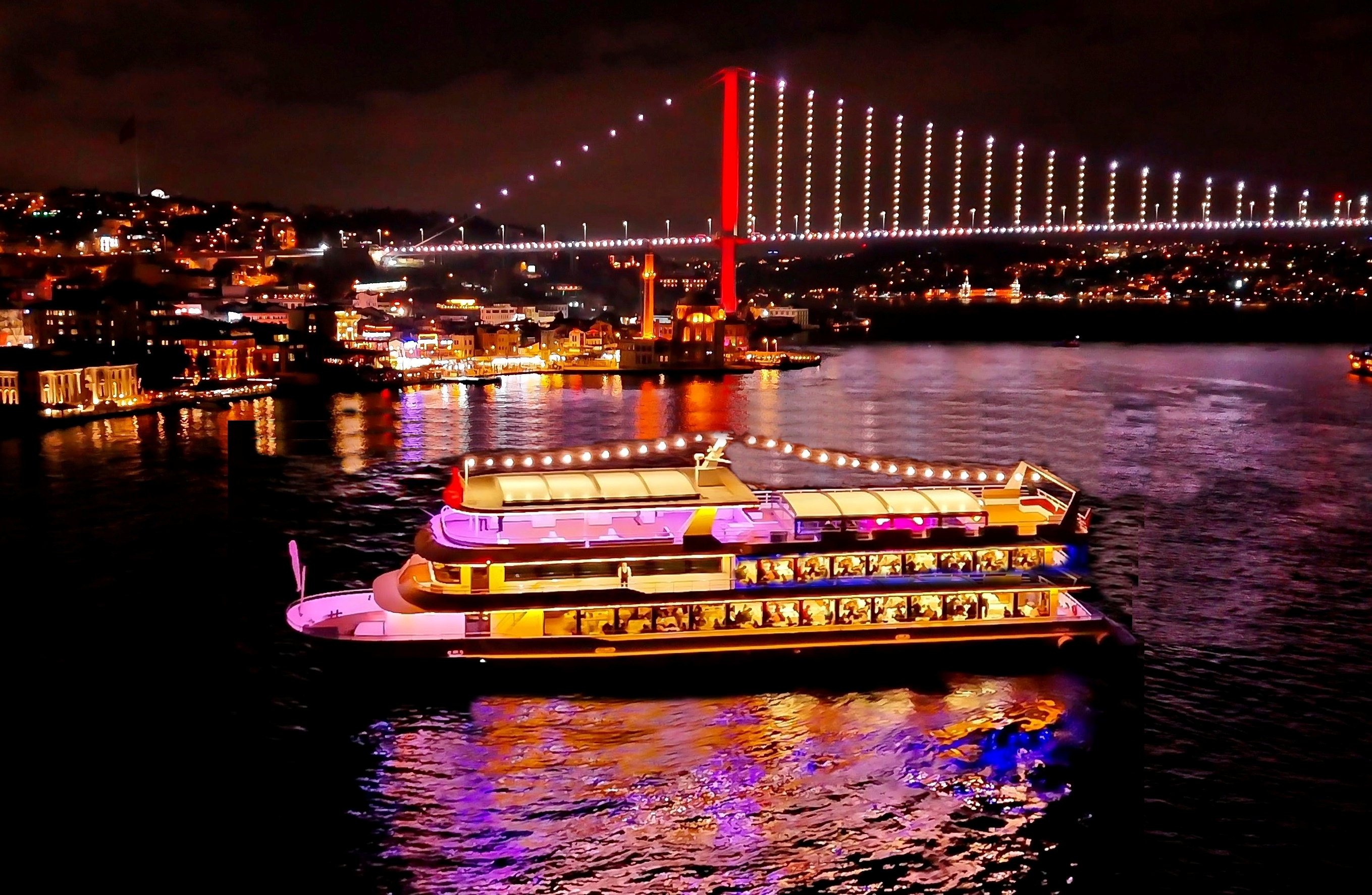
Sail the Bosphorus by night with dinner, drinks, and live folk and flamenco dance shows.
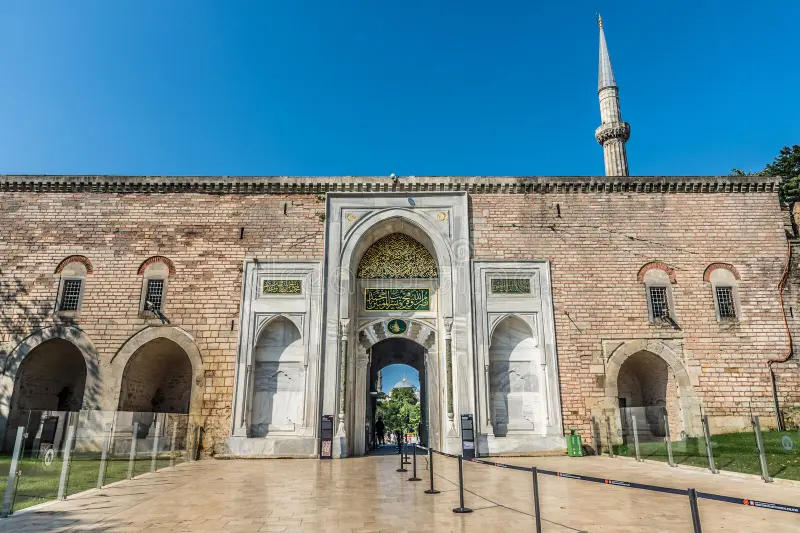
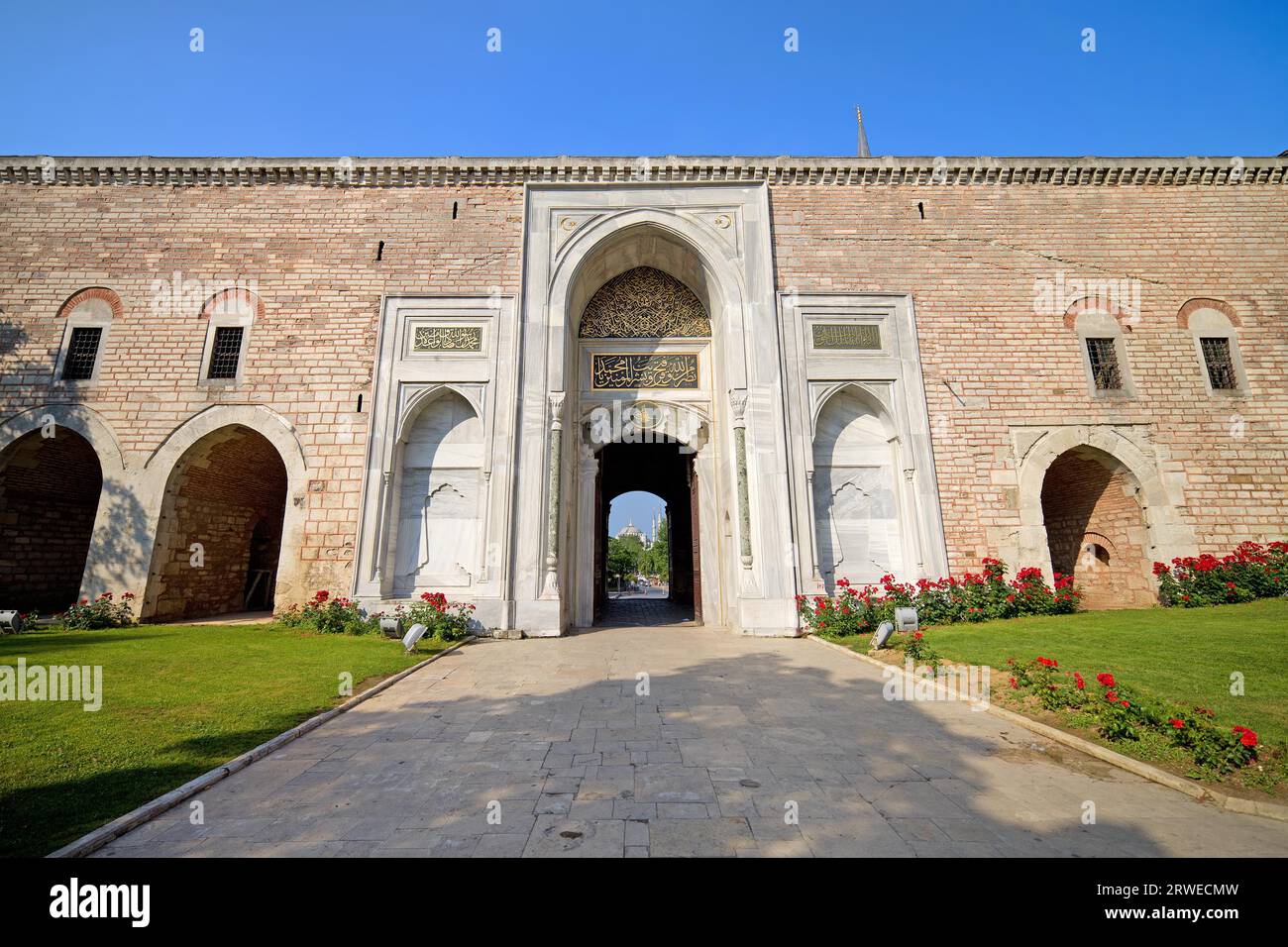
Enter through Bab-ı Hümayun, the outer gate that gives the address its name, and pass Hagia Irene on the way to the ticket checkpoint
Head straight for the Harem entrance before tour groups arrive, then view the Divan and Palace Kitchens along the same courtyard
Queue for the Third Courtyard treasury rooms to see the Topkapi Dagger and Spoonmaker's Diamond
Visit the Privy Chamber housing relics attributed to the Prophet Muhammad and other prophets
Finish among the Baghdad Kiosk and Iftar Pergola with views over the Bosphorus and Golden Horn
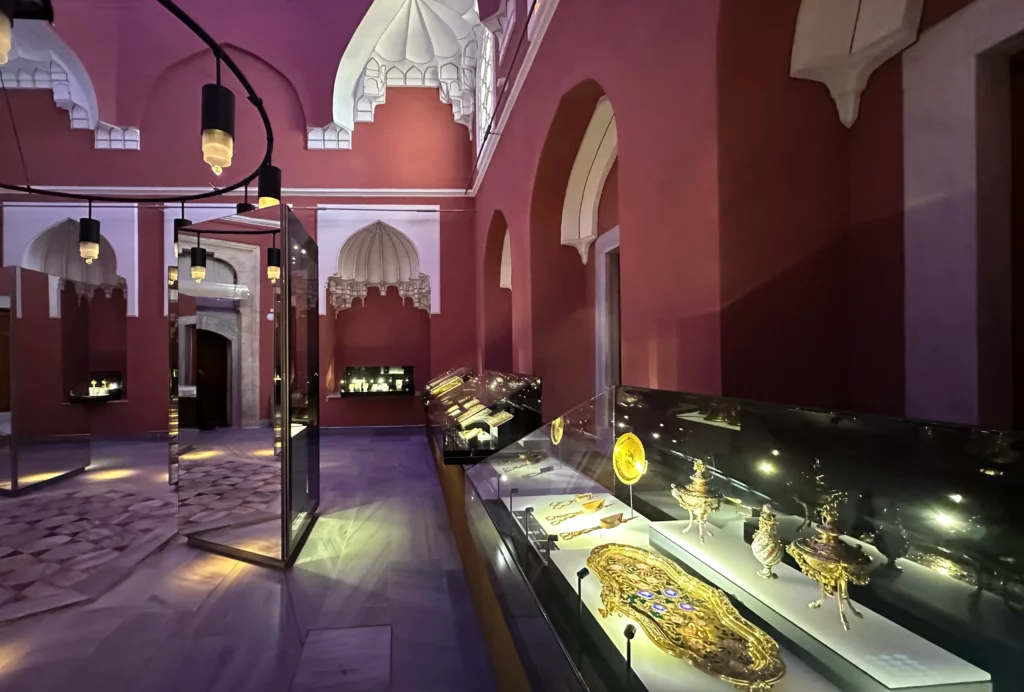
Housed in the Third Courtyard's former Conqueror's Pavilion, this six-room hall displays the 86-carat Spoonmaker's Diamond and the emerald-studded Topkapi Dagger, made in 1747 as a diplomatic gift that never reached its intended recipient. Weapons and armor spanning roughly 1,300 years fill adjoining rooms, forming one of the most extensive collections of its kind.
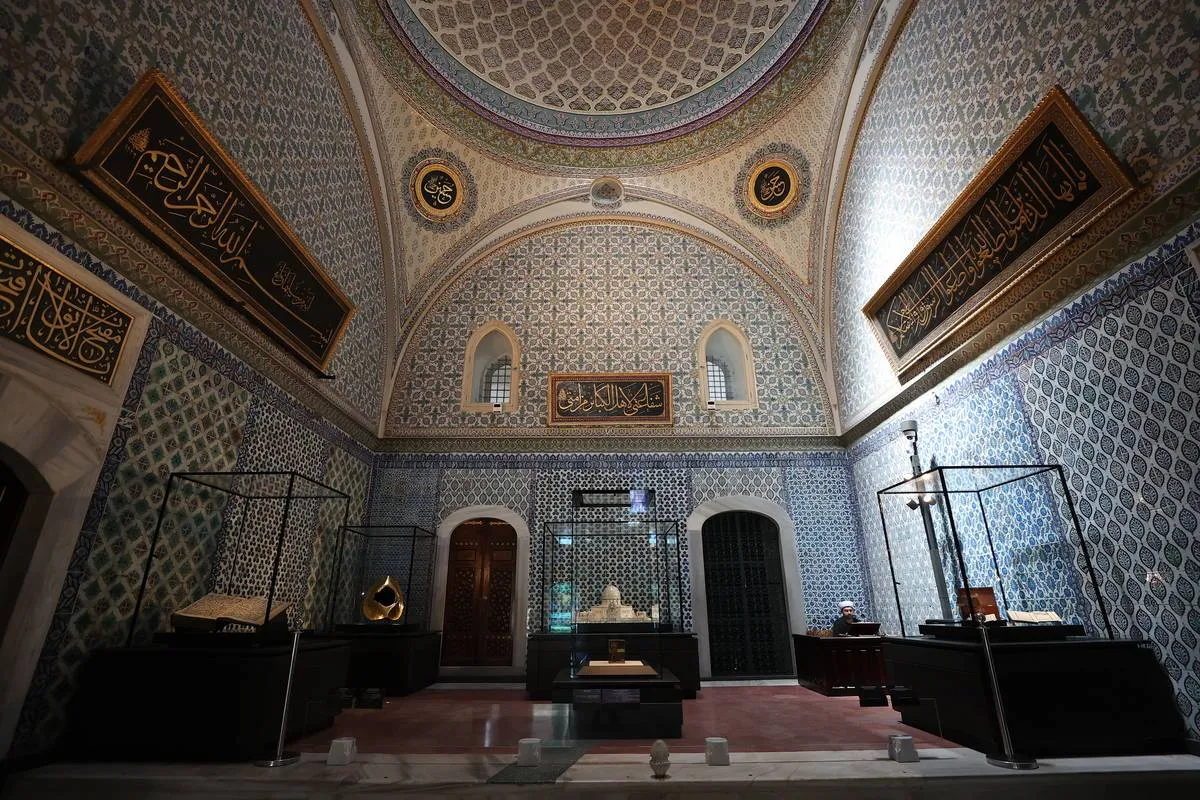
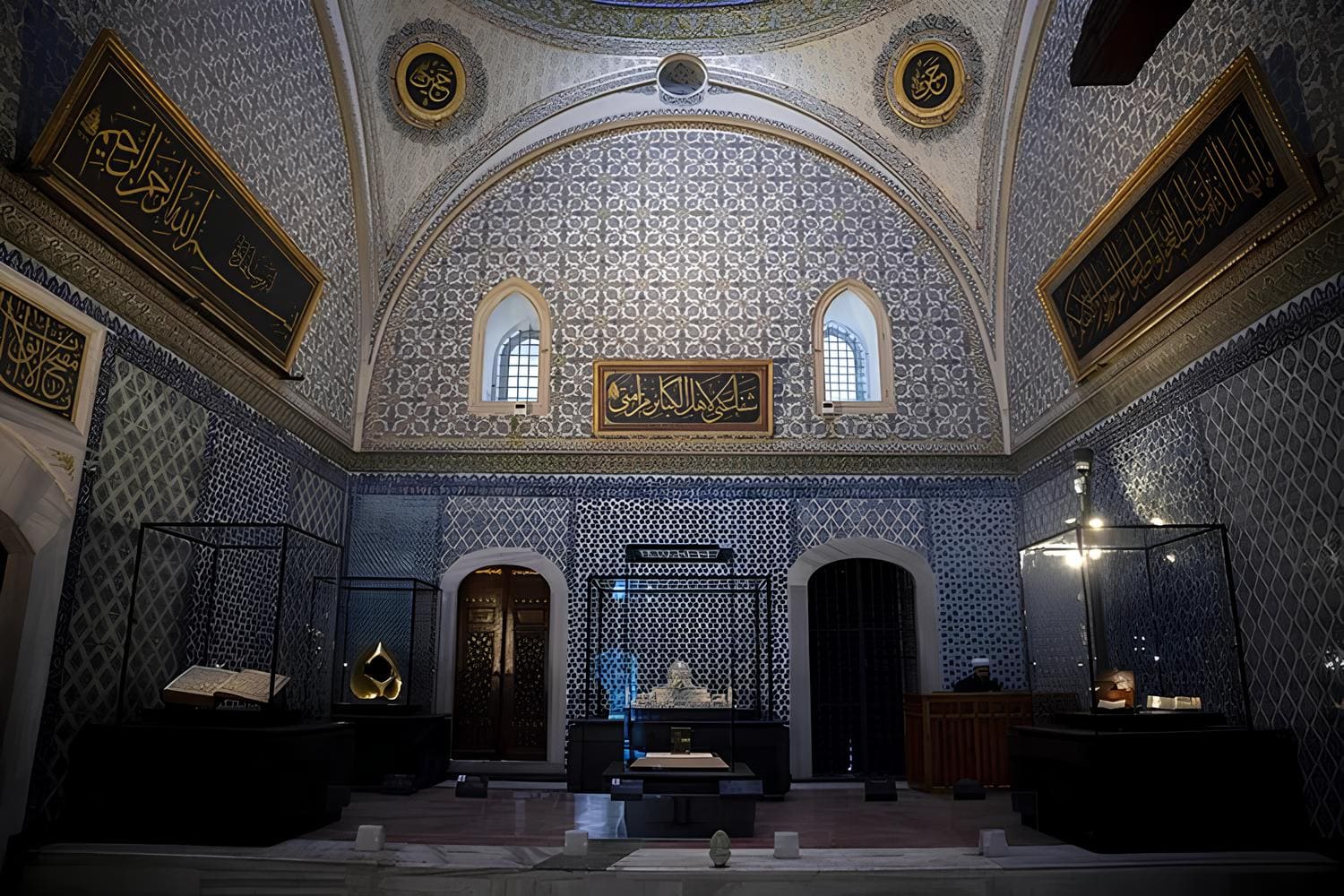
Located in the Privy Chamber of the Third Courtyard and tiled in Iznik ceramics, this collection includes items attributed to the Prophet Muhammad alongside relics linked to Moses, David, Abraham, and Joseph. It ranks among the most significant assemblages of Islamic religious artifacts anywhere in the world.
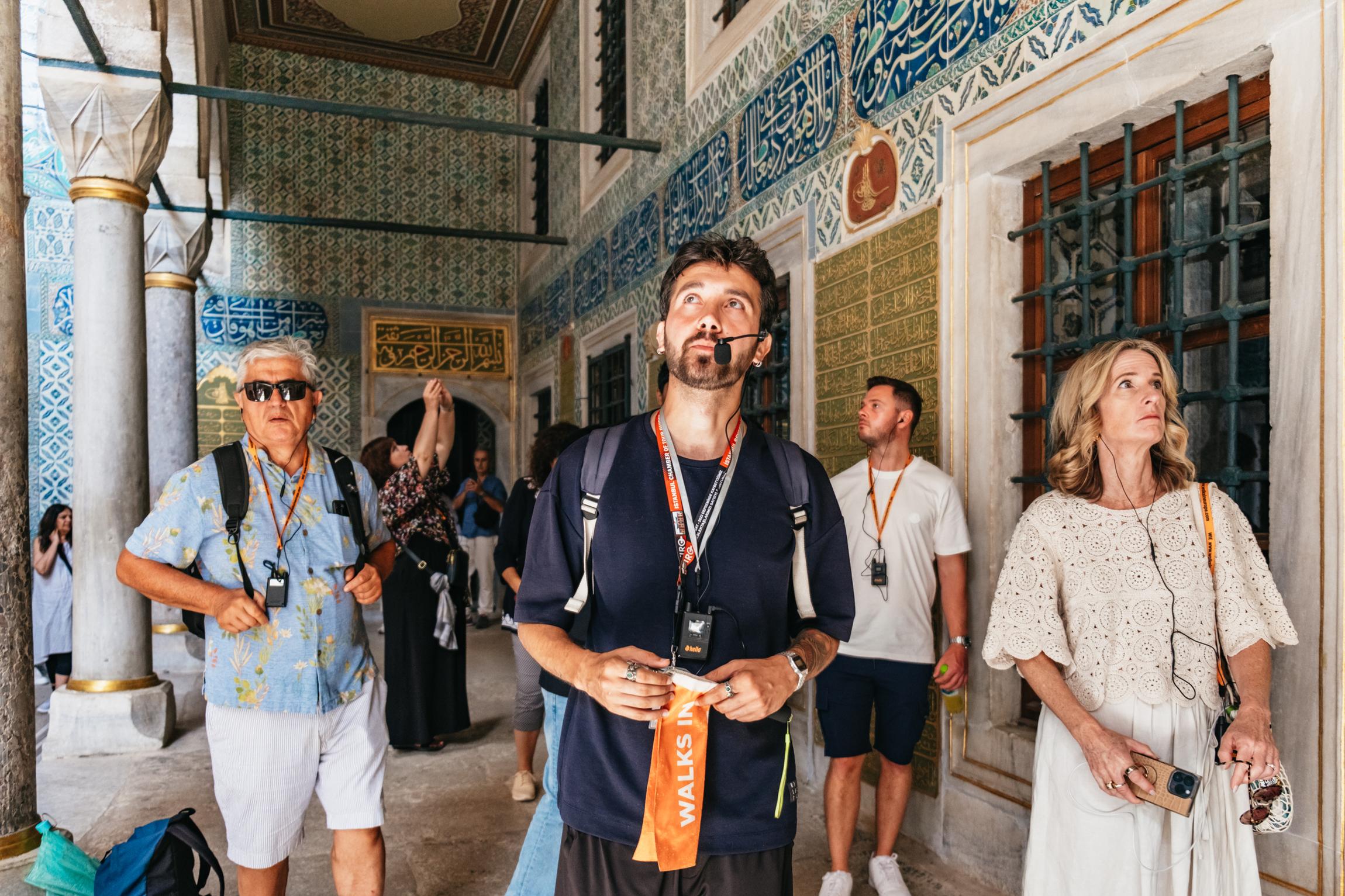
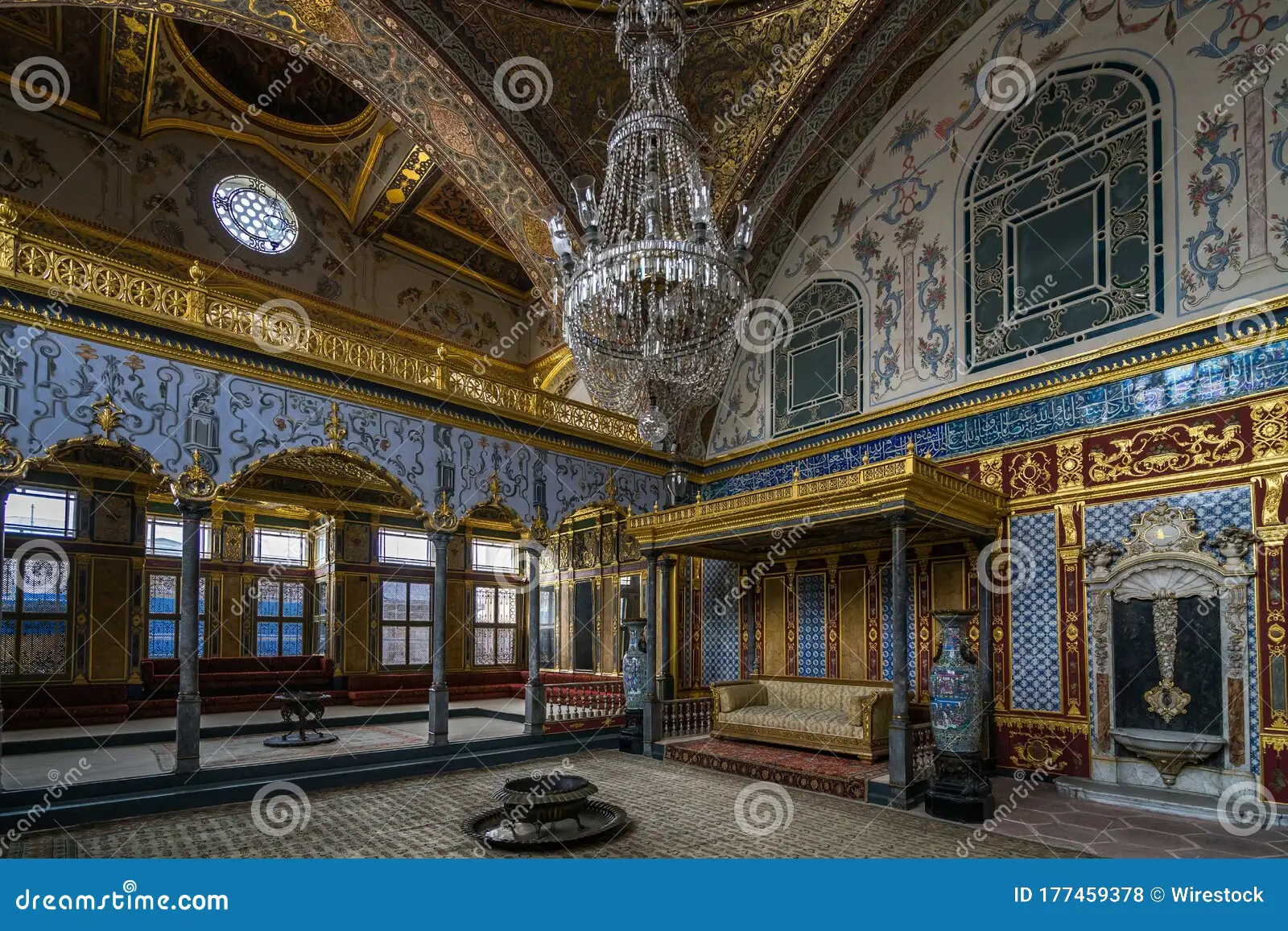
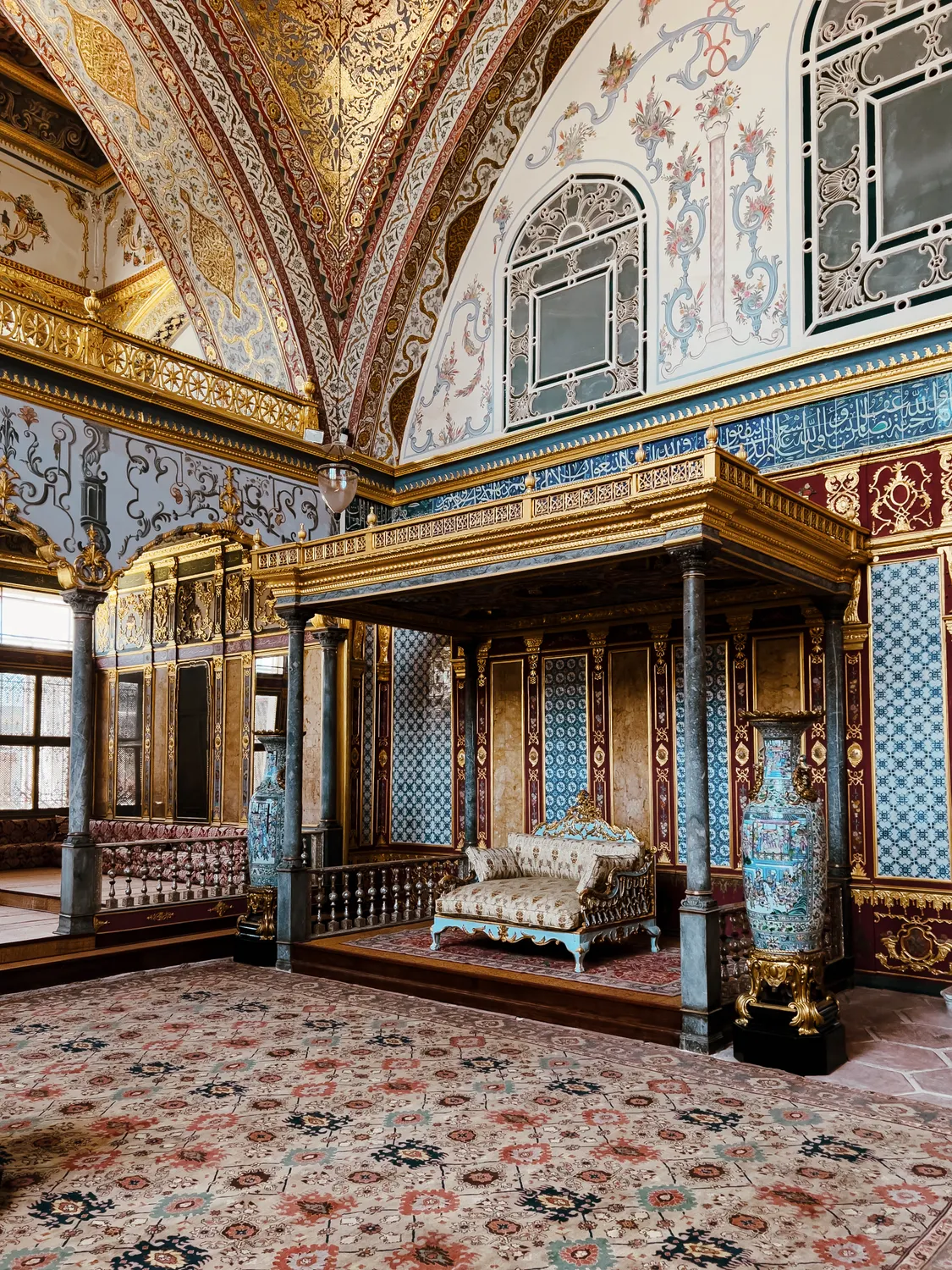
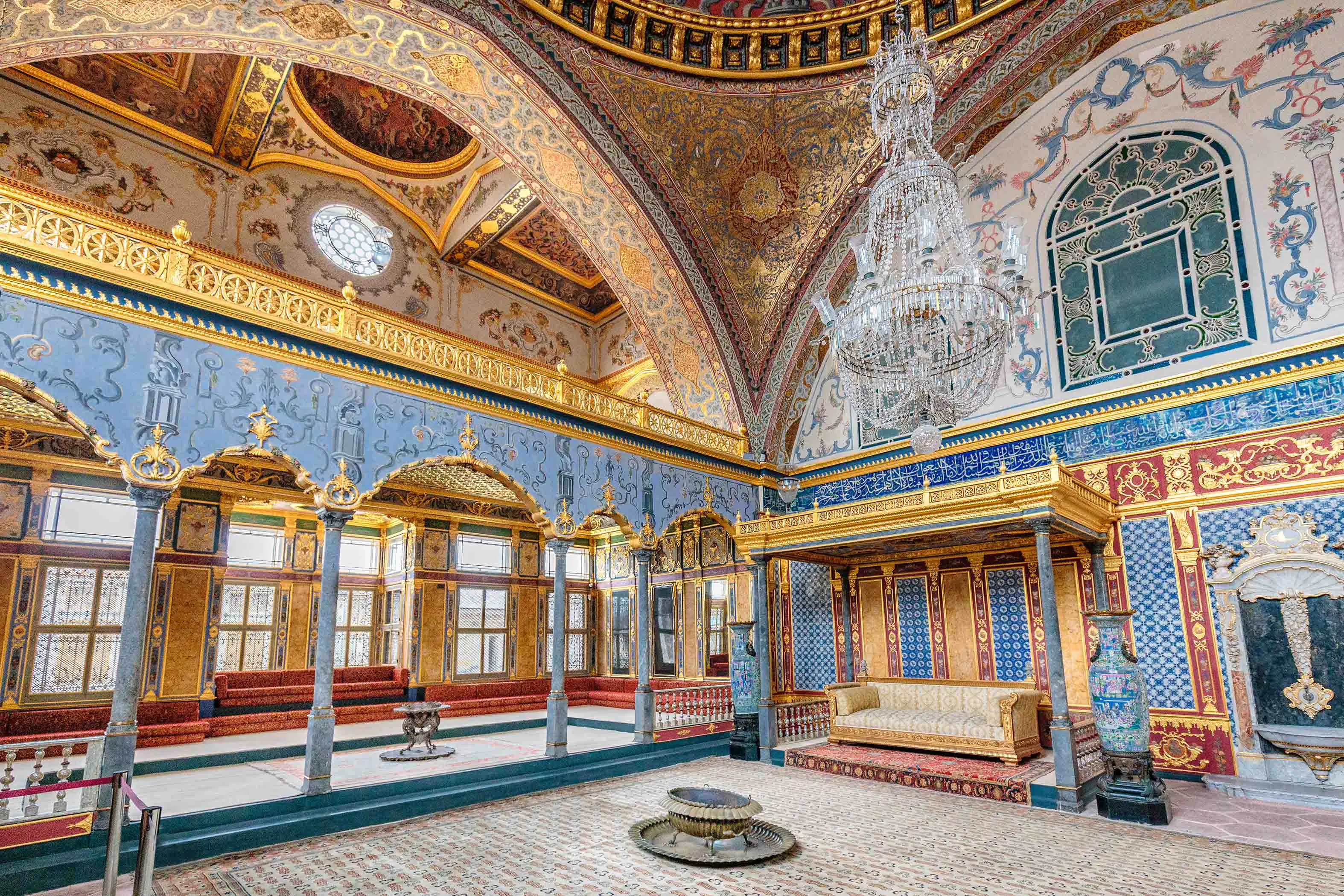
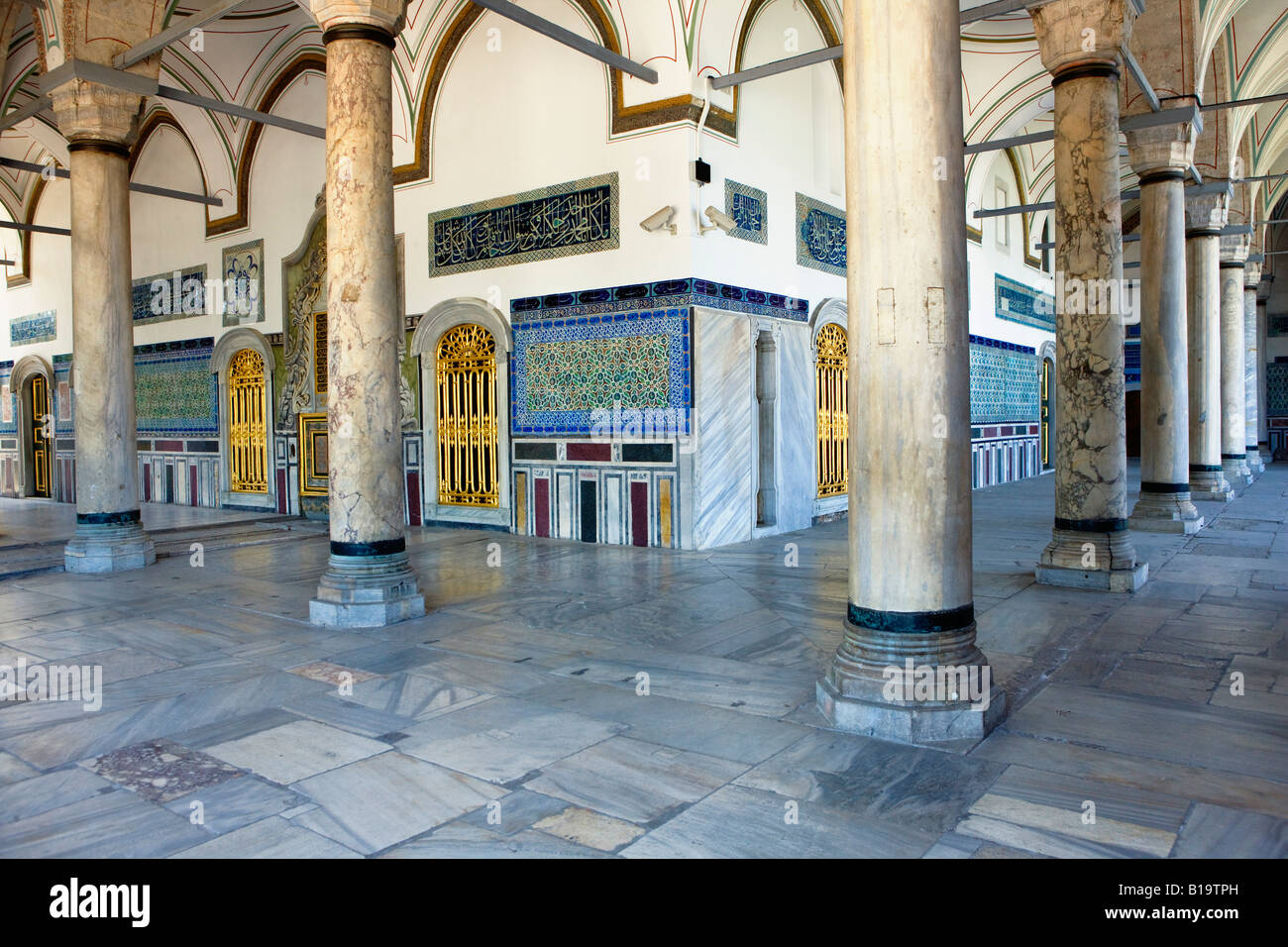
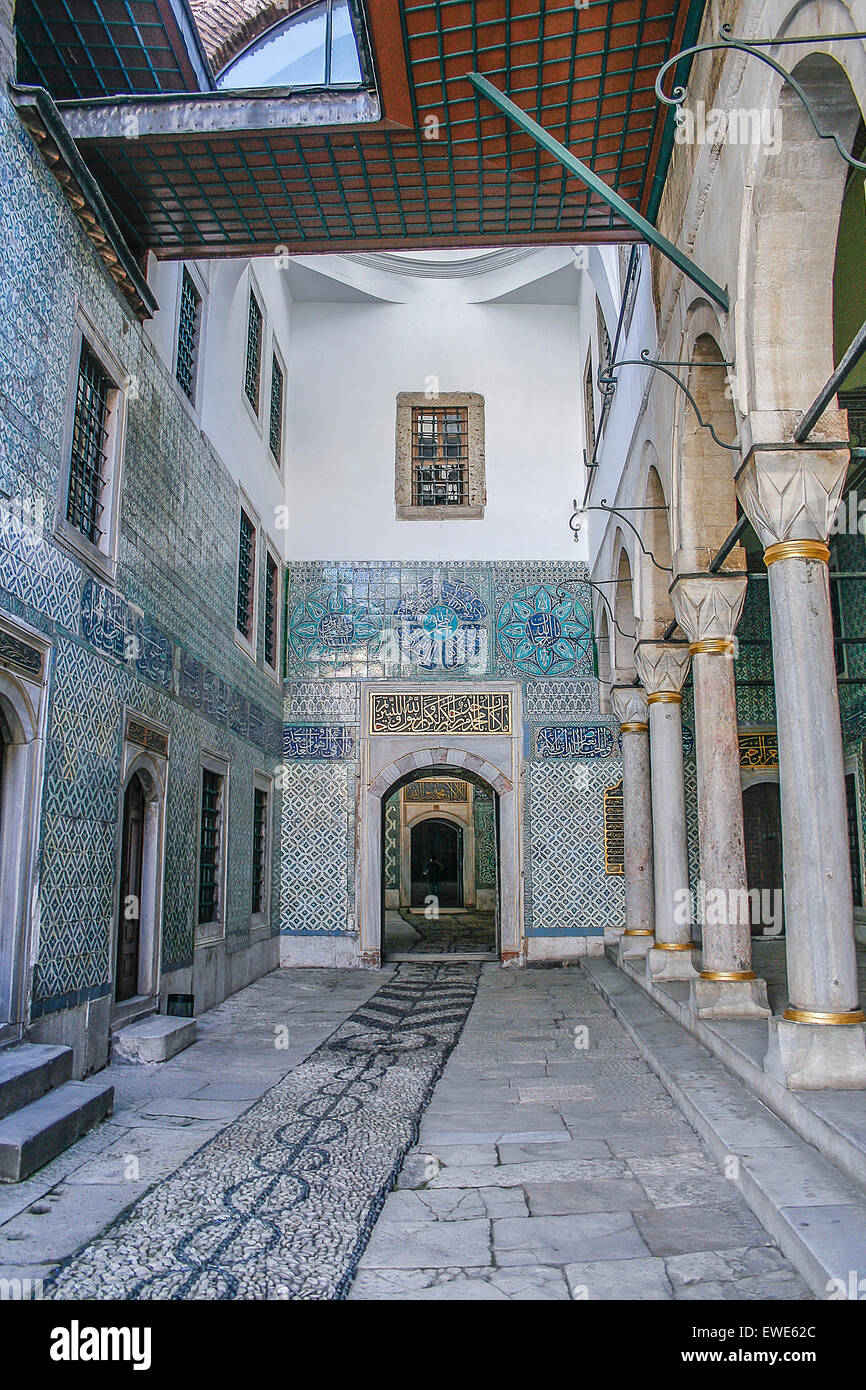
A self-contained wing of over 400 rooms within the Second Courtyard, the Harem was home to the Sultan's family, concubines, and eunuch guards, decorated throughout with Iznik tilework in the Valide Sultan's courtyard and apartments. The Imperial Hall, or Hünkâr Sofası, served as the largest domed ceremonial space where the Sultan hosted family celebrations.
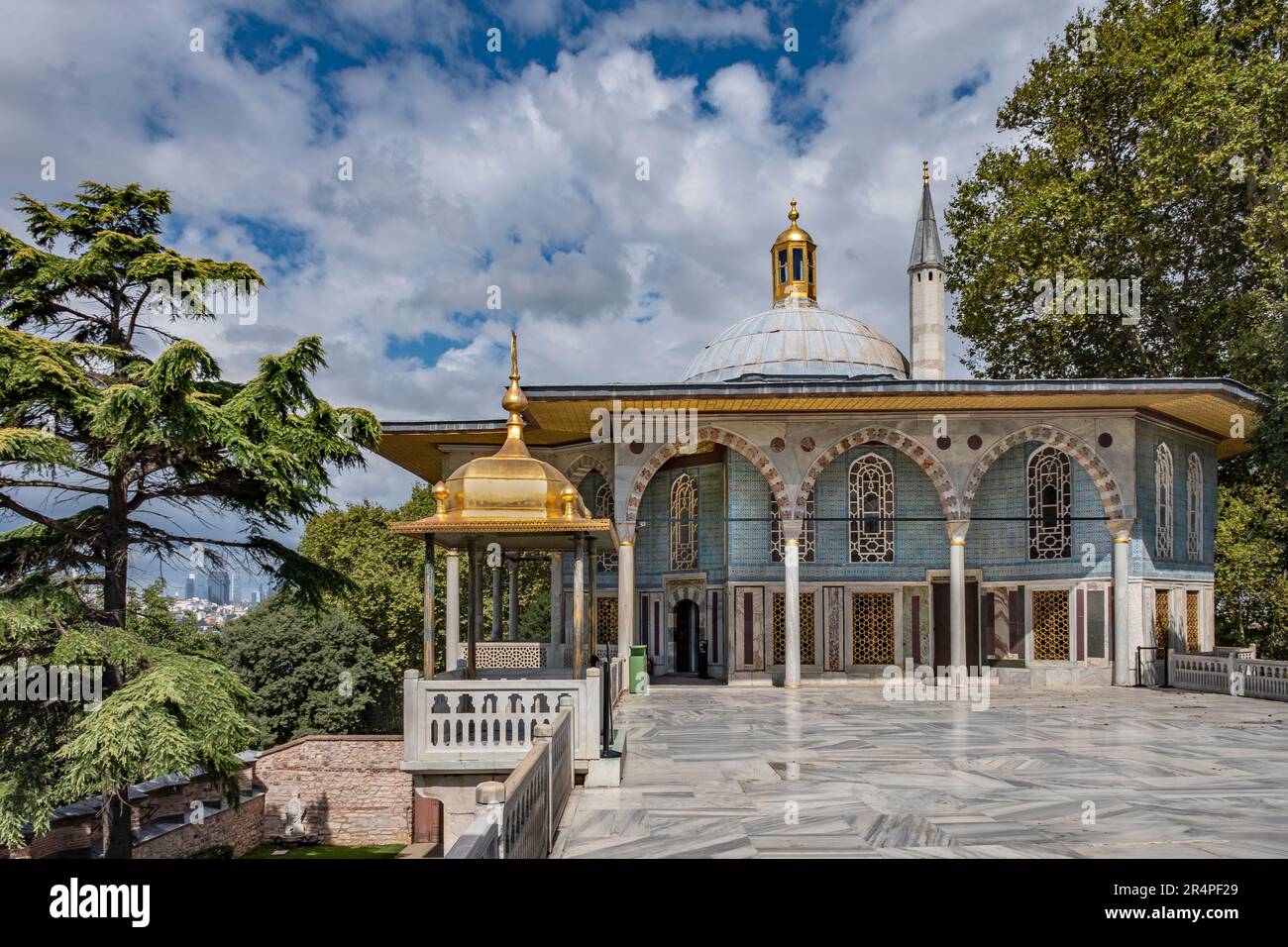
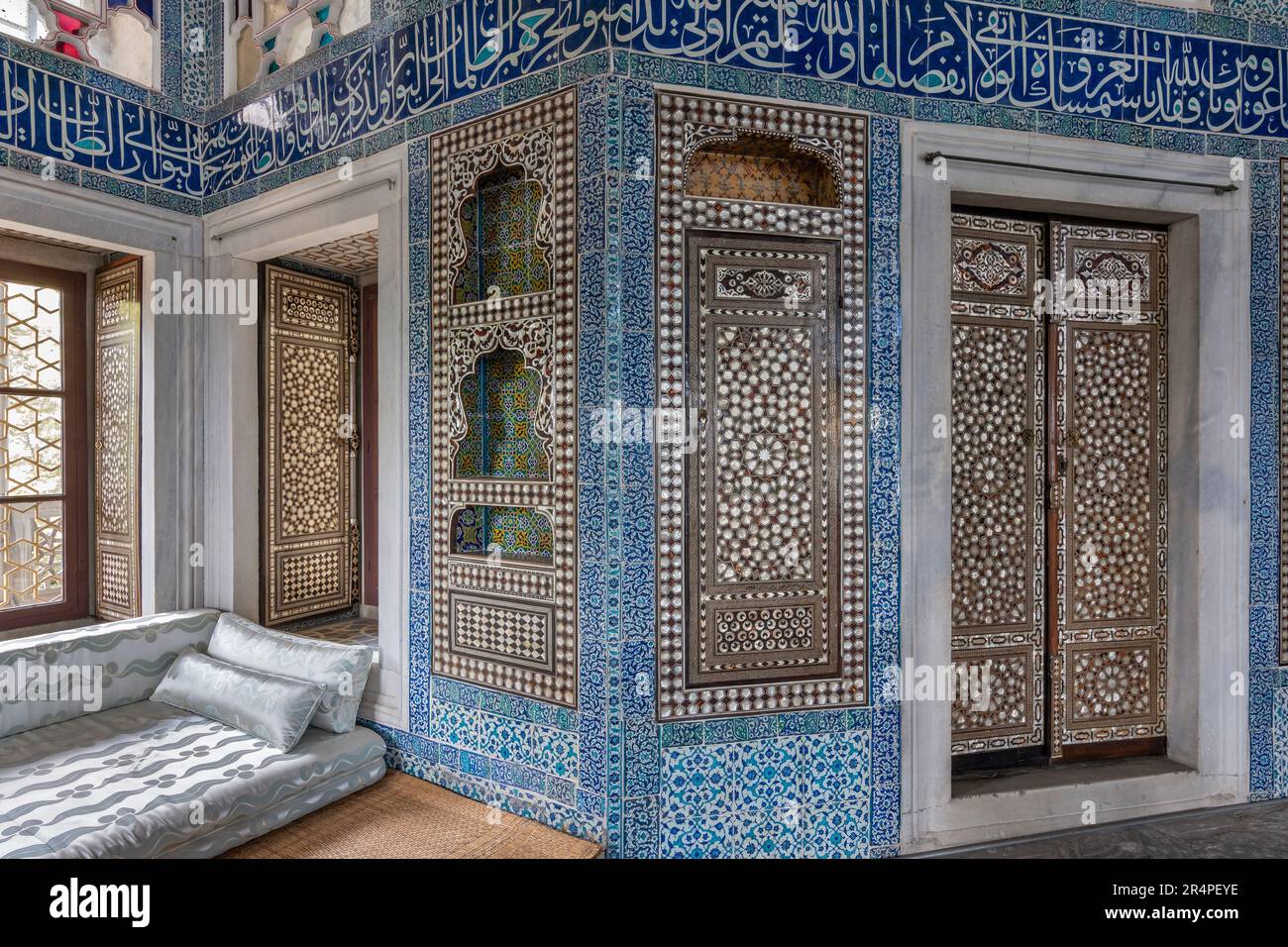
Built in the Fourth Courtyard to commemorate a 17th-century military campaign, this pavilion is decorated with colorful period tilework, mother-of-pearl inlay, and tortoiseshell paneling. It stands among the best-preserved examples of classical Ottoman pavilion architecture on the palace grounds.
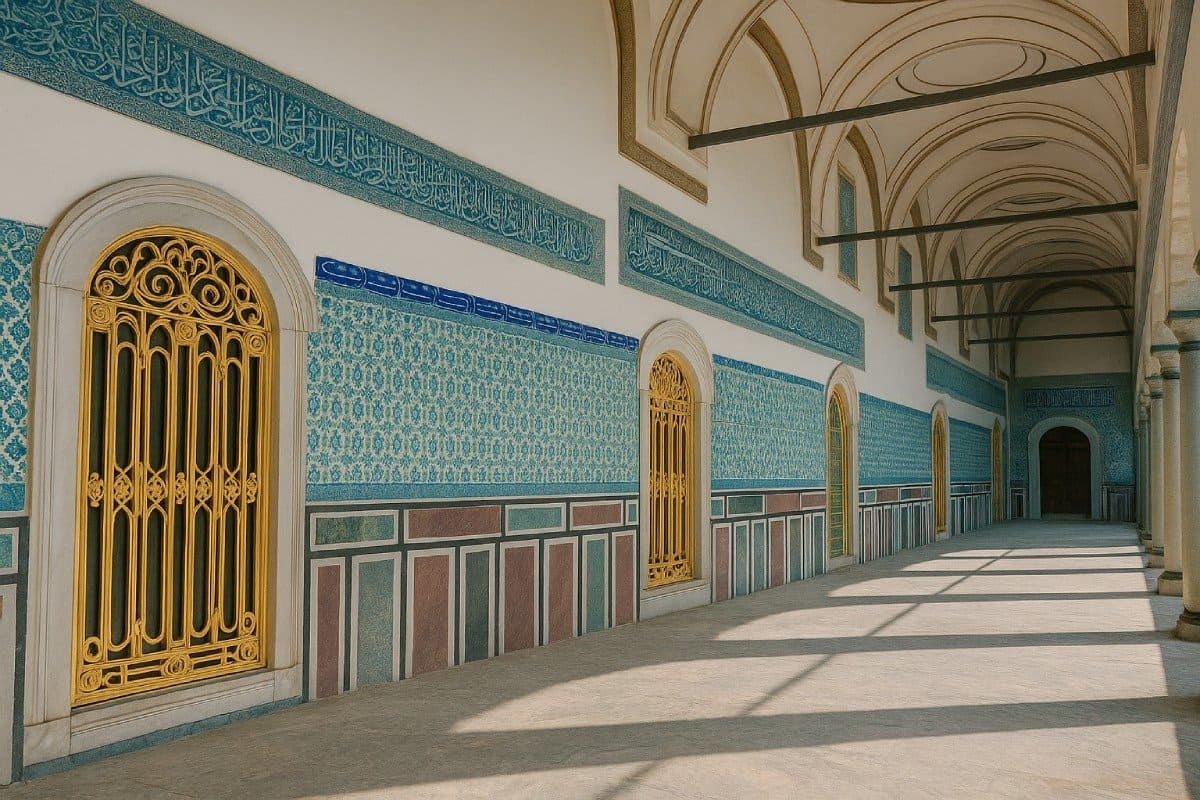
Set in the Fourth Courtyard and known in Turkish as the Sünnet Odası, this small chamber covered in blue Iznik tiles was used for the ceremonial circumcision of Ottoman princes. Its exterior facade includes tile panels considered among the finest surviving examples from the period.
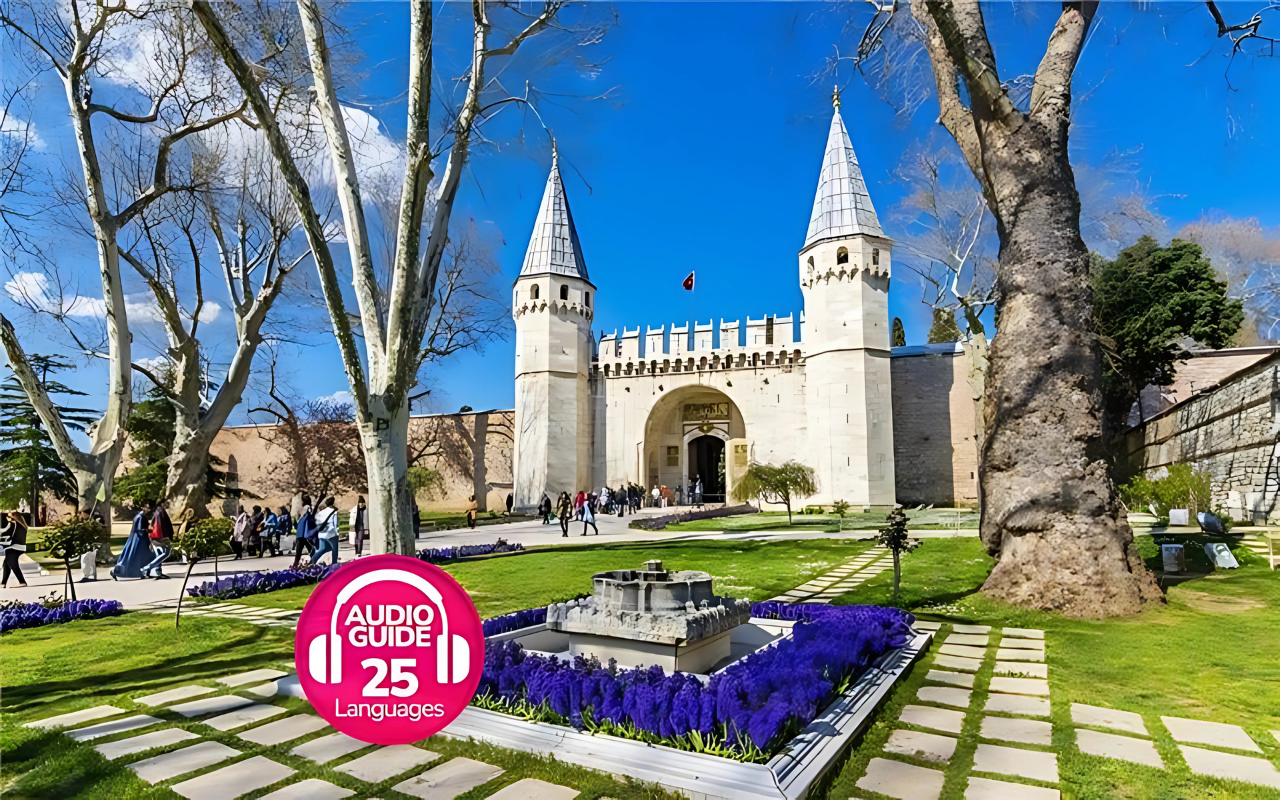
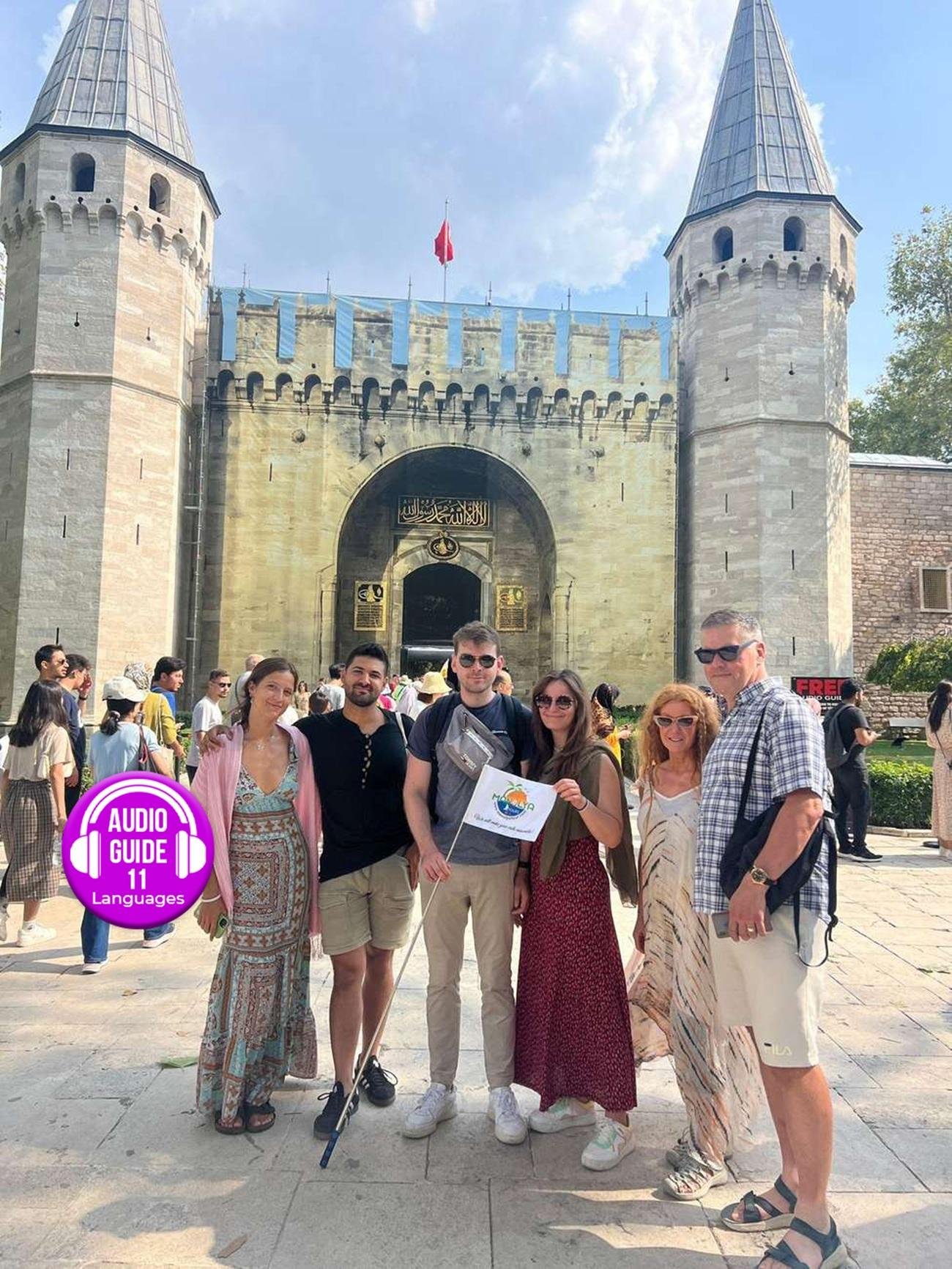
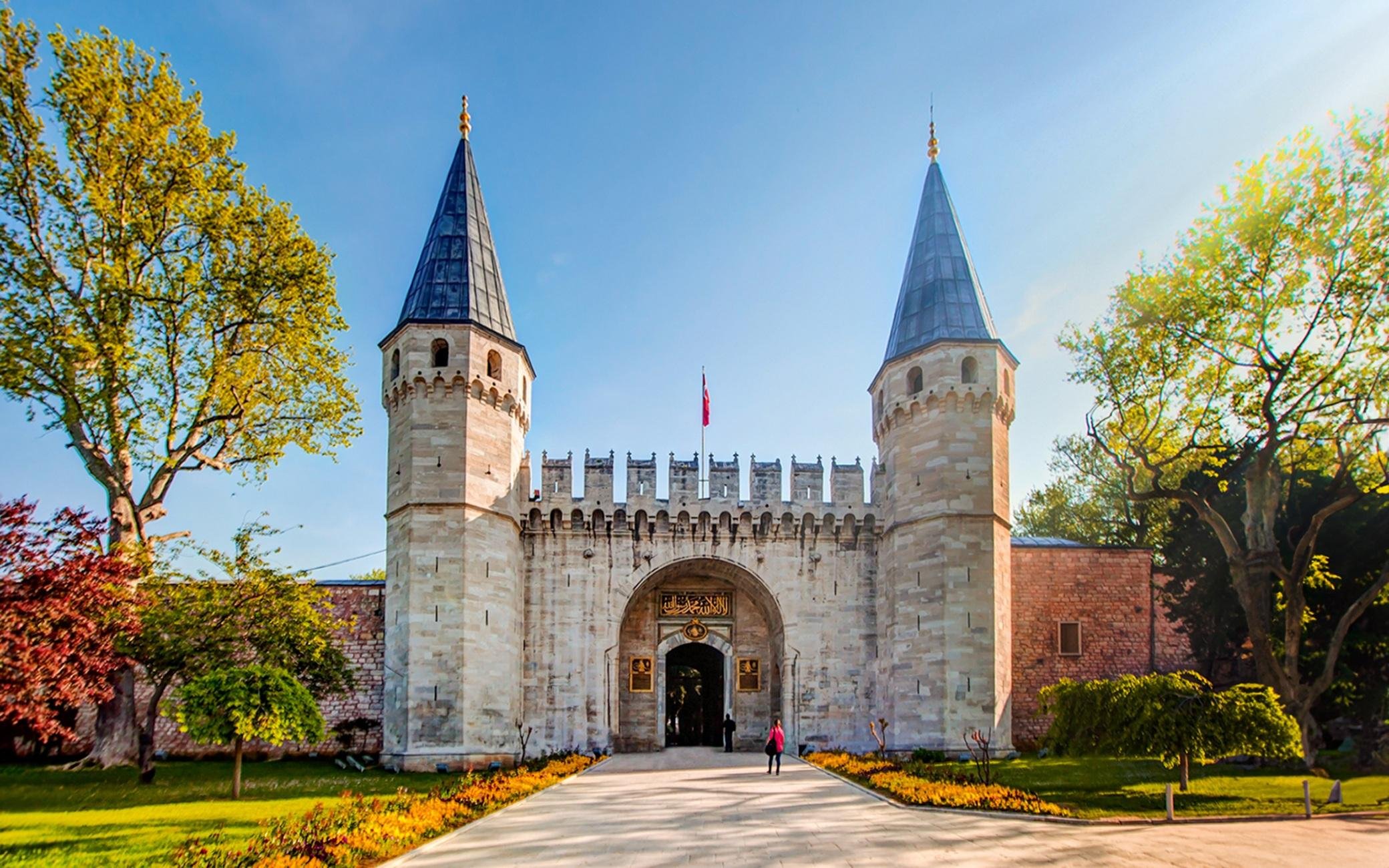
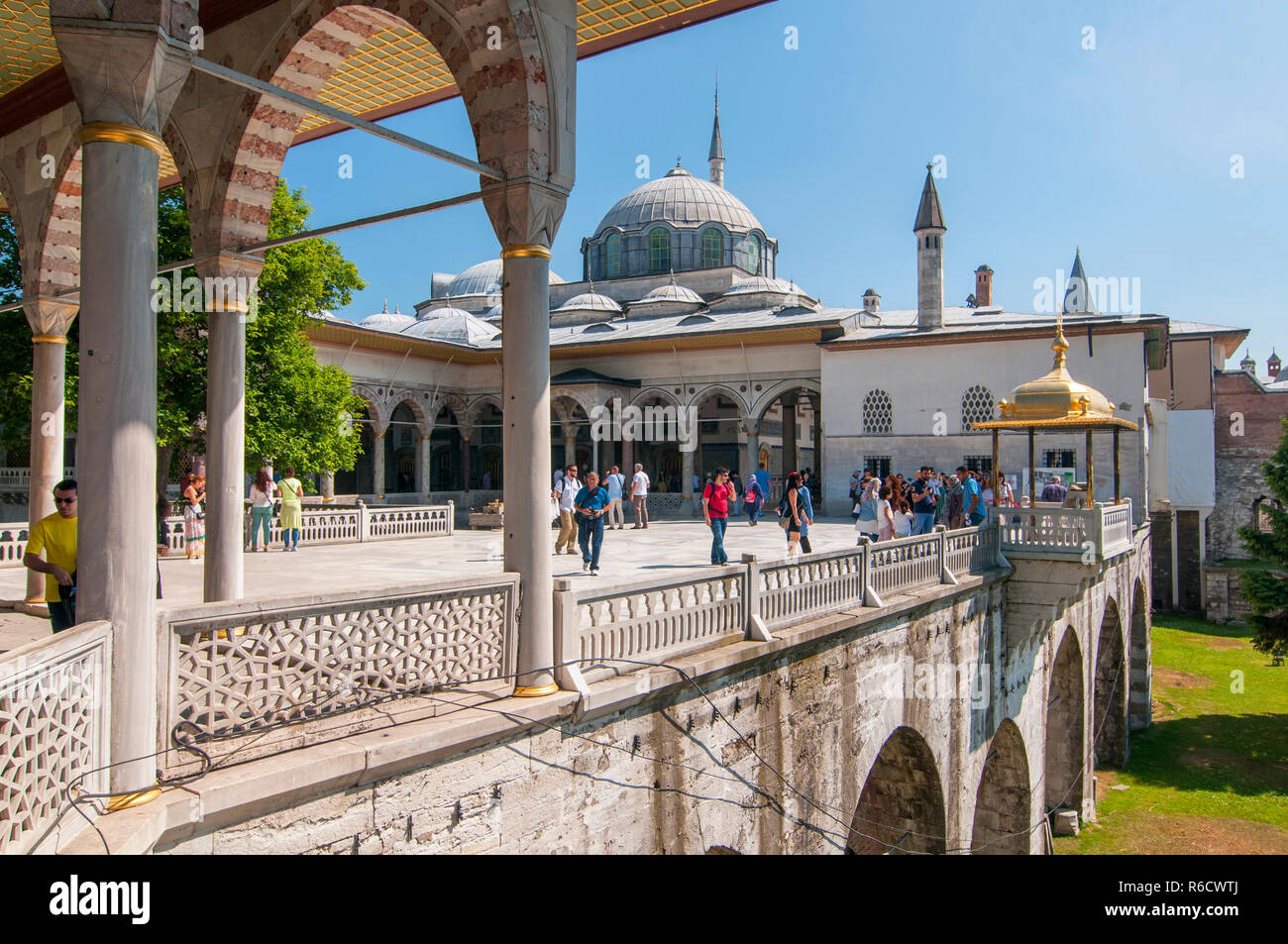
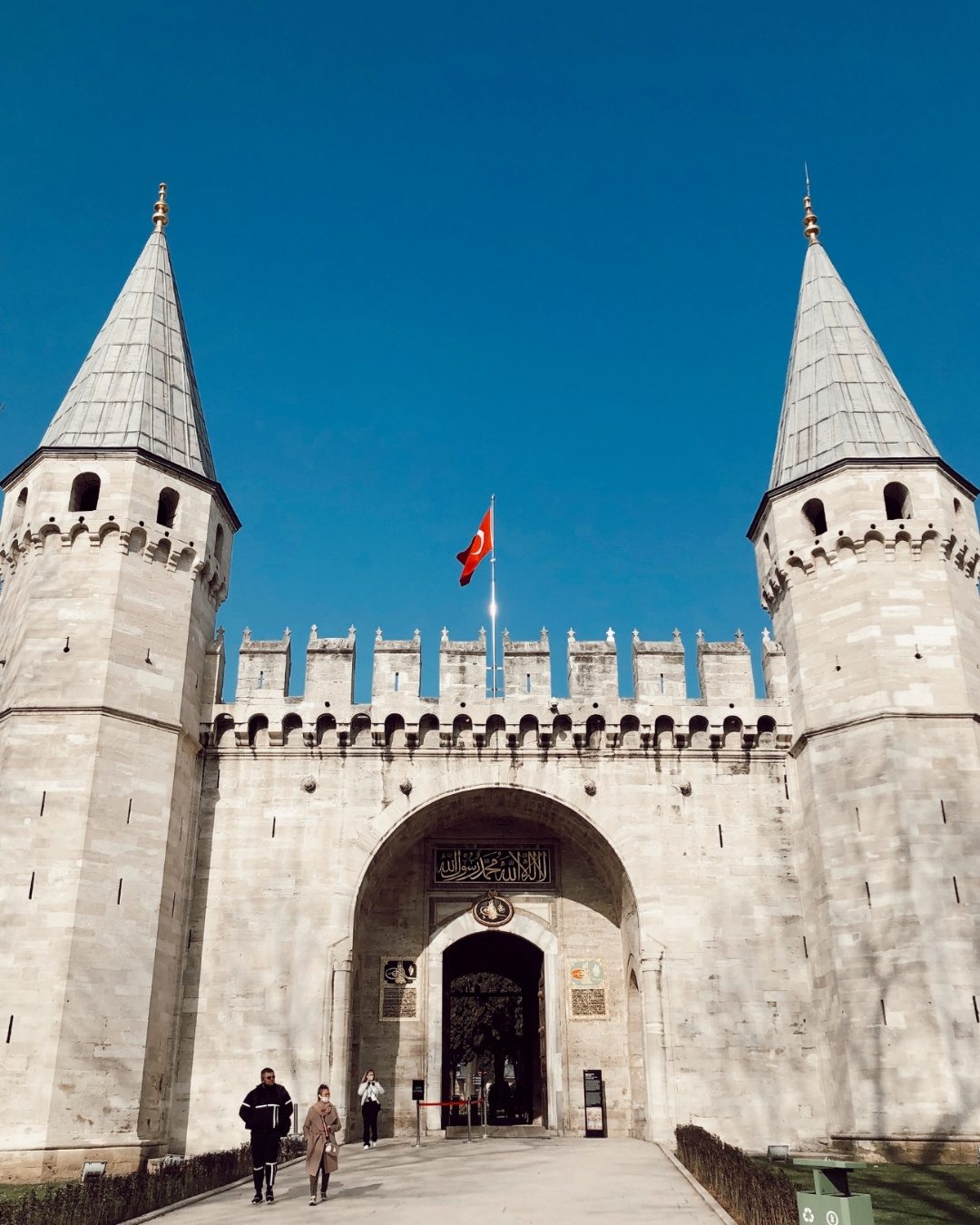
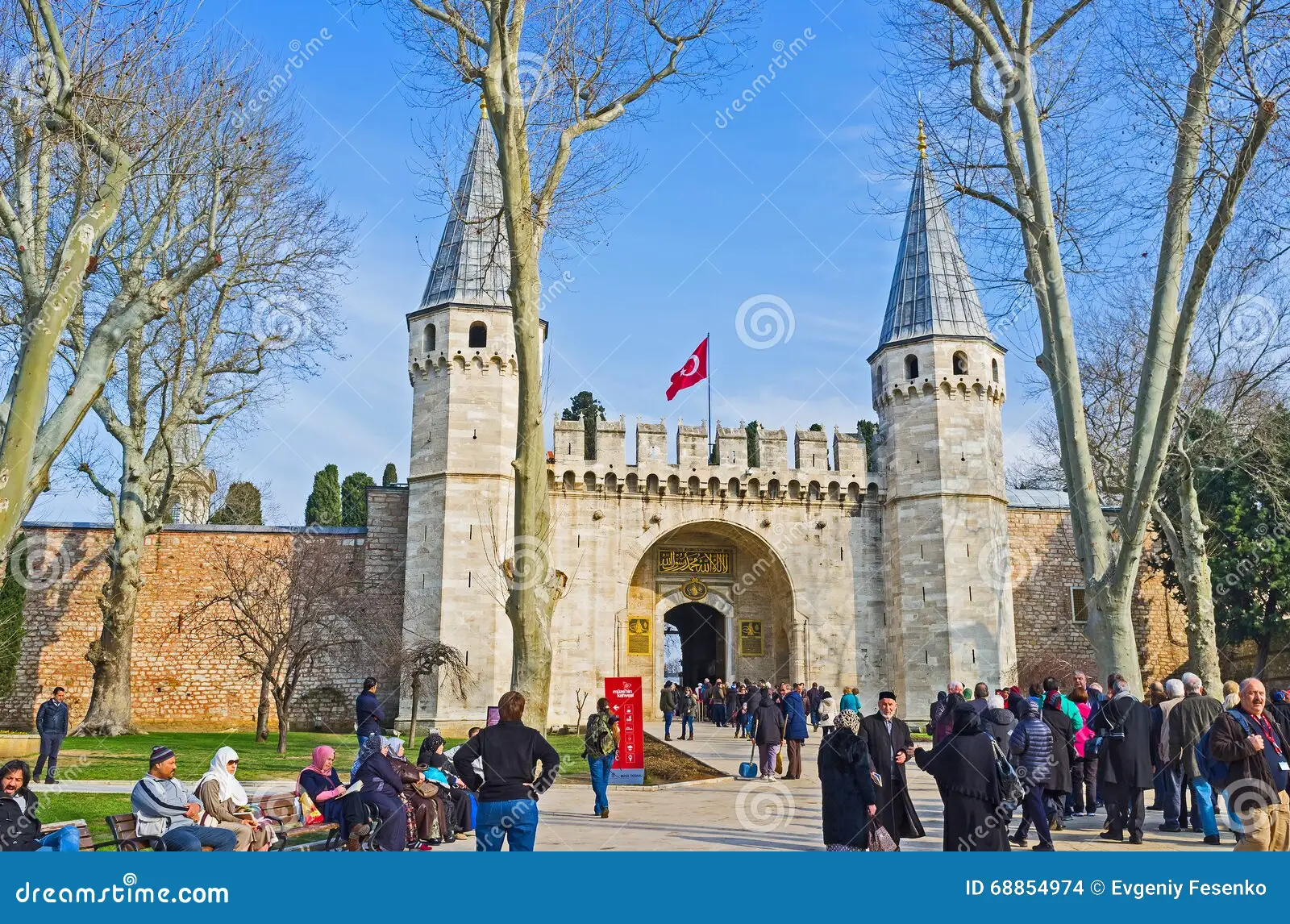
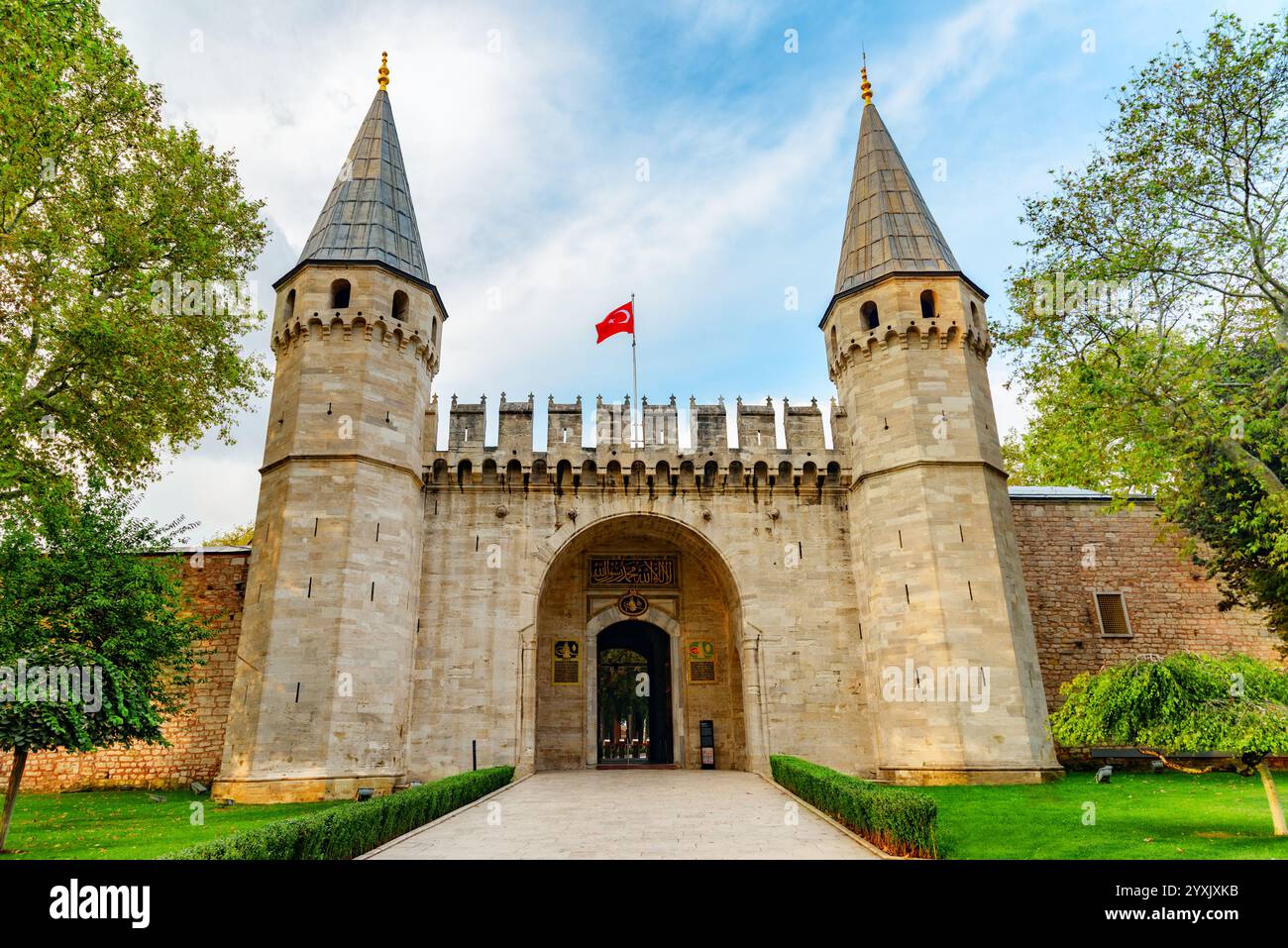
The monumental second gate leading into the palace's Second Courtyard, flanked by two conical towers, marks the point beyond which even foreign ambassadors had to proceed on foot rather than on horseback. Its twin towers have become one of the most photographed silhouettes of the complex.
You enter through the Imperial Gate on Babıhümayun Caddesi, the same threshold couriers once crossed at a run, and the noise of Sultanahmet drops away inside the First Court's plane trees.
Arrive between 09:00 and 10:30 and you walk straight past the Gate of Salutation while the coach groups are still forming ranks behind you.
You turn left in the Second Court for the Harem first — its queue thickens by eleven, and a Topkapi Palace Tickets tour that leaves it for later usually ends up shortened. Inside, you follow a fixed one-way route past the Courtyard of the Black Eunuchs, the Valide Sultan's apartments, and the domed Imperial Hall, tile giving way to gilt as the centuries advance underfoot.
Back outside, you cross to the Treasury and slow down; the emerald dagger draws a crush, so you circle the room and return. You cross the Third Court, pause where the recitation carries from the Sacred Relics chambers, and then keep walking east until the buildings stop.
The Fourth Court is where you sit. Marble terraces open onto the Golden Horn and the Bosphorus below, ferries stitching between two continents. You take the Baghdad Kiosk last, then double back toward the exit, keeping the 16:30 last-entry cutoff in mind before your Topkapi Palace Tickets tickets stop admitting you anywhere new.
All the details about your upcoming adventure in one place
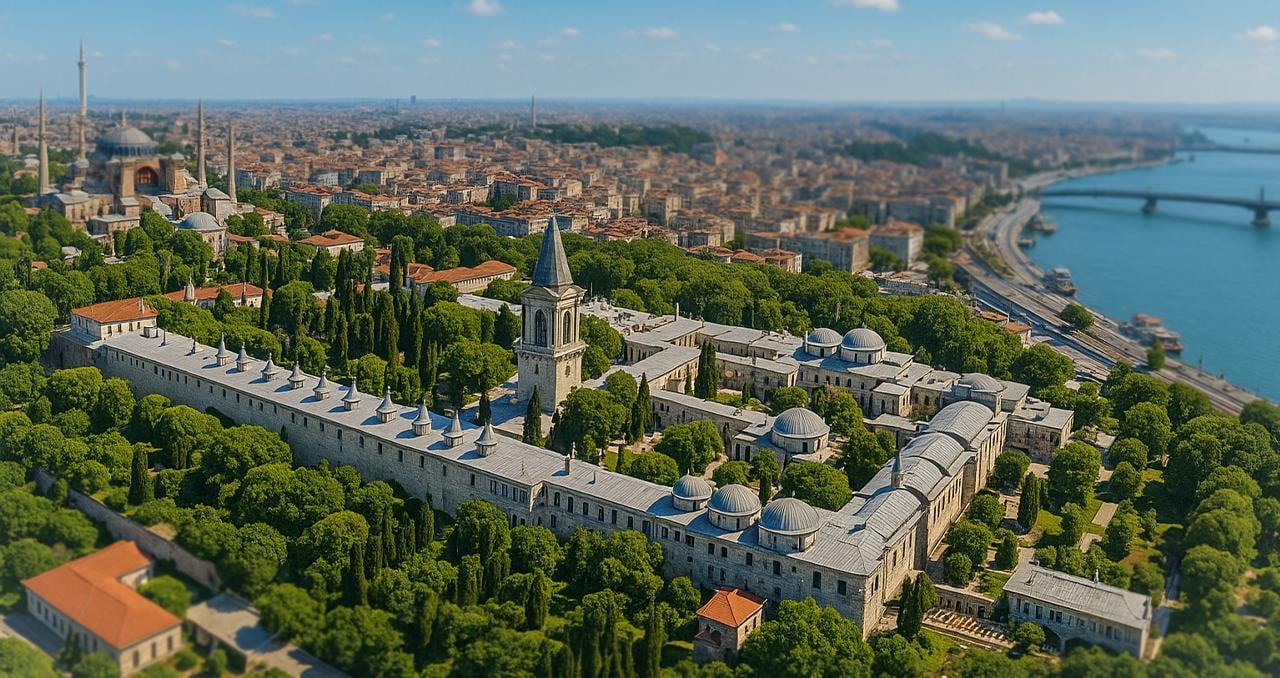
Topkapi Palace Tickets open the gates to the residence that housed Ottoman sultans and their court for roughly four centuries above Seraglio Point. Beyond the Gate of Salutation lie four successive courtyards, the Imperial Treasury with the Spoonmaker's Diamond, the Sacred Relics rooms, and the tiled chambers of the Harem, all overlooking the meeting of the Bosphorus and the Golden Horn. Guided Topkapi Palace Tickets tours pair these spaces with the Baghdad and Revan Kiosks, the palace kitchens, and the Fourth Courtyard terraces.
The palace was never meant to be one building. Mehmed II ordered it raised on Seraglio Point in 1459, six years after the conquest of Constantinople, and his architects answered with a loose confederation of pavilions, kitchens, courtyards and colonnades spread across roughly 700,000 square metres of headland.
Sultans governed here until 1856, when Abdülmecid I moved the court to Dolmabahçe on the European shore. The complex reopened as a museum in 1924, among the first acts of the young republic.
What survives is less a palace than a diagram of Ottoman power, drawn in stone. Visitors holding Topkapi Palace Tickets pass inward through four courtyards, each more restricted than the last. The First Court was public ground, open to petitioners. The Second held the Imperial Council chamber, the Divan, where viziers debated beneath a latticed window through which the sultan could listen unseen. The Third belonged to the Enderun, the palace school. The Fourth dissolves into terraces, tulip gardens and the Baghdad Kiosk, built in 1639 to mark Murad IV's campaign, its interior sheathed in blue-and-white İznik tile and mother-of-pearl.
The collections are the reason the site retains its gravity. The Imperial Treasury holds the Topkapi Dagger with its three cabochon emeralds and the 86-carat Spoonmaker's Diamond. The Sacred Relics chambers keep objects attributed to the Prophet Muhammad, where a Quran reciter has read continuously since Selim I brought them from Cairo in 1517. The Harem, a warren of some 300 rooms, housed the sultan's mother, consorts and children behind doors that most Istanbul palace tour itineraries once skipped entirely; it now forms part of the standard admission at 2,750 TRY.
Architecturally, the palace resists European symmetry. There is no grand axis, no single façade to photograph whole. Buildings accreted across four centuries, damaged by the fires of 1574 and 1665 and rebuilt in the taste of each era, so a sixteenth-century Sinan-school portico may open onto rococo gilding added under Ahmed III. The Ottomans built in the manner of a nomadic court that had settled but not forgotten the tent — clusters of separate structures, linked by gardens.
The site anchors the Historic Areas of Istanbul, inscribed by UNESCO in 1985, and sits within walking distance of Hagia Sophia and the Basilica Cistern. Skip-the-line Topkapi Palace entry matters here for a practical reason: the Harem operates its own queue, and the palace closes on Tuesday. Topkapi Palace Tickets tours remain the busiest single ticketed movement in Sultanahmet, and the courtyards absorb crowds unevenly.

There is no grand axis, no single façade to photograph whole — the palace resists being seen all at once.
There is no strict dress code for the Palace museum sections, but modest clothing is expected since the complex includes small mosque spaces such as the Mosque of the Agas. Comfortable flat shoes matter more than formality, since the four courtyards involve long stretches of uneven cobblestone.
Airport-style security screening with metal detectors and X-ray scanners is set up at the Imperial Gate before entry to the First Courtyard. Large suitcases and oversized backpacks are discouraged and may need to be left at a bag check point, so travelers arriving straight from a hotel checkout should plan accordingly.
Photography without flash is permitted in the courtyards, gardens, and most galleries of the Palace, including the Harem. Flash and video recording are prohibited inside the Imperial Treasury and the Sacred Relics Room to protect the objects on display.
Children aged 0–6 enter free, making the Palace a workable stop for families with young kids, though strollers struggle on the cobblestones and stairs inside pavilions like the Baghdad Kiosk. The Fourth Courtyard gardens and terraces offer open space where children can move around after the more tightly packed Treasury and Harem corridors.
The Palace's four courtyards are connected by cobblestone paths and some stepped transitions, which make full wheelchair access difficult in a few pavilions, including parts of the Harem. Wheelchairs can be requested at the entrance, and the main First and Second Courtyards are comparatively level and manageable.
Outside food and drink are not permitted inside the exhibition halls, though there are on-site cafés and a restaurant in the palace gardens with Bosphorus views. Bottled water is generally allowed and recommended, especially in the shadeless Third and Fourth Courtyards during summer.
Weekly closure day
Popular day, moderate midday crowds
Busiest day of the week
Crowded late morning to early afternoon
Hours
Wed–Sun & Mon 09:00–17:00, closed Tuesdays
Address
Cankurtaran Mah. Babı Hümayun Cad. No:1, 34122 Sultanahmet, Fatih, Istanbul, Turkey
Access
Cobblestone courtyards, partial ramp access, some steps into pavilions
Best arrival
09:00–10:30 to beat tour groups before Harem lines build up
Bag policy
Large backpacks and suitcases screened at entry, small bags preferred
Layout
Four sequential courtyards plus separate Harem wing
Public transport · 25-35 min from Taksim · Tram fare approx. 15-27 TRY with Istanbulkart
Take the T1 tram line and alight at the Sultanahmet or Gülhane stop, both roughly a 5-10 minute walk from the Palace entrance near Hagia Sophia.
Walk · 3-10 min from Hagia Sophia · Free
From Sultanahmet Square or Hagia Sophia, it is a short, flat walk along Soğukçeşme Sokak directly to the Imperial Gate.
Taxi · 15-25 min from most Istanbul hotels · Metered, moderate cost
Taxis and rideshare apps can drop passengers near Soğukçeşme Sokak close to the main gate, though Sultanahmet's narrow streets and pedestrian zones limit how close cars can get.
Car · Variable with traffic · Paid parking scarce
Driving is discouraged since Sultanahmet has extremely limited parking and heavy restrictions in the historic peninsula.
Topkapi Palace Tickets booked online can typically be cancelled up to 24 hours before the visit date for a full refund; same-day cancellations are generally non-refundable. The palace ticket price of 2,750 TRY (foreign adult, Palace incl. Harem) is the figure used for any refund calculation.
Recommended time
2.5-5 hours
Most visitors need 2.5 to 3 hours for the courtyards and Treasury alone, while a full loop through the Harem and Sacred Relics Room stretches a Topkapi Palace Tickets visit to 4 or 5 hours. Add 45-90 minutes if the Harem is on your list, since it requires a separate ticket and its own queue. Arriving in the 09:00-10:30 window keeps that Harem line short before tour buses unload; arriving after 11:00 can add real waiting time at both the security checkpoint and the Harem entrance. Skip-the-line Topkapi Palace Tickets tours help most on days when the standard queue is already long by mid-morning.
Crowd levels through the day
Weather · crowds · average price — dots go green to amber to red as each metric rises.
Mild temperatures around 15-20°C and thinner crowds than summer, though April and May can bring occasional rain showers.
Peak tourist season with temperatures reaching 28-32°C and the heaviest queues at the Harem and Treasury entrances.
Comfortable weather in the low-to-mid 20s°C with noticeably shorter lines than summer, generally regarded as a favorable shoulder season.
Coolest and quietest period, with temperatures often between 5-10°C and the lightest visitor numbers of the year.
The Harem wing inside the Second Courtyard fills up fastest once tour buses arrive mid-morning, so visiting it right after entry helps avoid the longest queue of the day.
Pre-purchased tickets skip the ticket-window line, though everyone still passes through the same security screening at the Imperial Gate.
Because last entry is 16:30, arriving after mid-afternoon leaves limited time to see the Treasury, Harem, and Sacred Relics Room in one pass.
The Third and Fourth Courtyards have little shade, and Istanbul summers regularly exceed 28°C, so bottled water bought outside the gate helps on longer visits.
Entering via Gülhane Park rather than directly from Sultanahmet Square spreads out arrival crowds and offers a quieter walk up to the ticket area.
Staff check tickets separately at the Harem entrance and sometimes at the Treasury, so keep the physical or digital ticket accessible throughout the visit rather than only at the main gate.
Cankurtaran Mah. Babı Hümayun Cad. No:1, 34122 Sultanahmet, Fatih, Istanbul
Main entrance, adjacent to Hagia Sophia and the Fountain of Ahmed III
Get directionsGülhane Park, Cankurtaran, Fatih, Istanbul
Alternate approach for those arriving via Gülhane tram stop
Get directionsConstruction began in 1459, six years after Mehmed II took Constantinople. The sultan chose Sarayburnu, the promontory where the Golden Horn meets the Sea of Marmara, and the Bosphorus beyond. Work on the first courtyards concluded around 1478. The Ottomans called it Yeni Saray, the New Palace. The name Topkapı, meaning Cannon Gate, came later, borrowed from a vanished shore pavilion. Anyone booking Topkapi Palace Tickets today enters through the Imperial Gate, Bab-ı Hümayun, completed in 1478 and inscribed with Mehmed's titles. The palace grew by accretion rather than plan. Süleyman the Magnificent expanded the kitchens after a fire in 1574; Mimar Sinan rebuilt them with their distinctive chimneys. The Harem, initially at the Old Palace in Beyazıt, moved here permanently under Murad III in the 1580s, and Sinan built the Privy Chamber of Murad III in 1578, still the finest İznik-tiled room on the site. The Imperial Council chamber, the Divan, sat beneath the Tower of Justice, where the sultan could listen unseen. Selim I is credited with bringing the Sacred Relics from Cairo in 1517, though the collection accumulated over centuries. Decline was gradual. Sultan Abdülmecid I moved the court to Dolmabahçe in 1856, leaving the older residence to caretakers, the treasury, and the mint. Fires in 1574 and 1665 had already destroyed much; the 1665 blaze gutted the Harem and the Divan. On 3 April 1924, by decree of Mustafa Kemal Atatürk, the complex opened to the public as a museum, one of the first acts of Republican heritage policy. Restoration has continued since. Visitors on Topkapi Palace Tickets tours now see the Spoonmaker's Diamond, the Topkapı Dagger, and Ottoman miniatures across four courtyards. A guided Istanbul palace tour explains what the walls conceal; independent holders of Topkapi Palace Tickets tickets should still read the gate inscriptions, which record the building's own chronology.
Mehmed II orders construction of a new palace on the Sarayburnu promontory above the Bosphorus.
The Imperial Gate and the earliest courtyards are completed, and the court relocates from Beyazıt.
Selim I returns from Cairo with the Sacred Relics of the Prophet, later housed in the Privy Chamber.
Mimar Sinan completes the Privy Chamber of Murad III, tiled in İznik ceramic.
The Harem is permanently transferred to the palace under Murad III, housing several hundred residents.
A major fire destroys much of the Harem and the Imperial Council chamber, prompting extensive rebuilding.
Abdülmecid I moves the imperial court to Dolmabahçe, ending four centuries of residence.
Atatürk's government converts the complex into a public museum on 3 April.
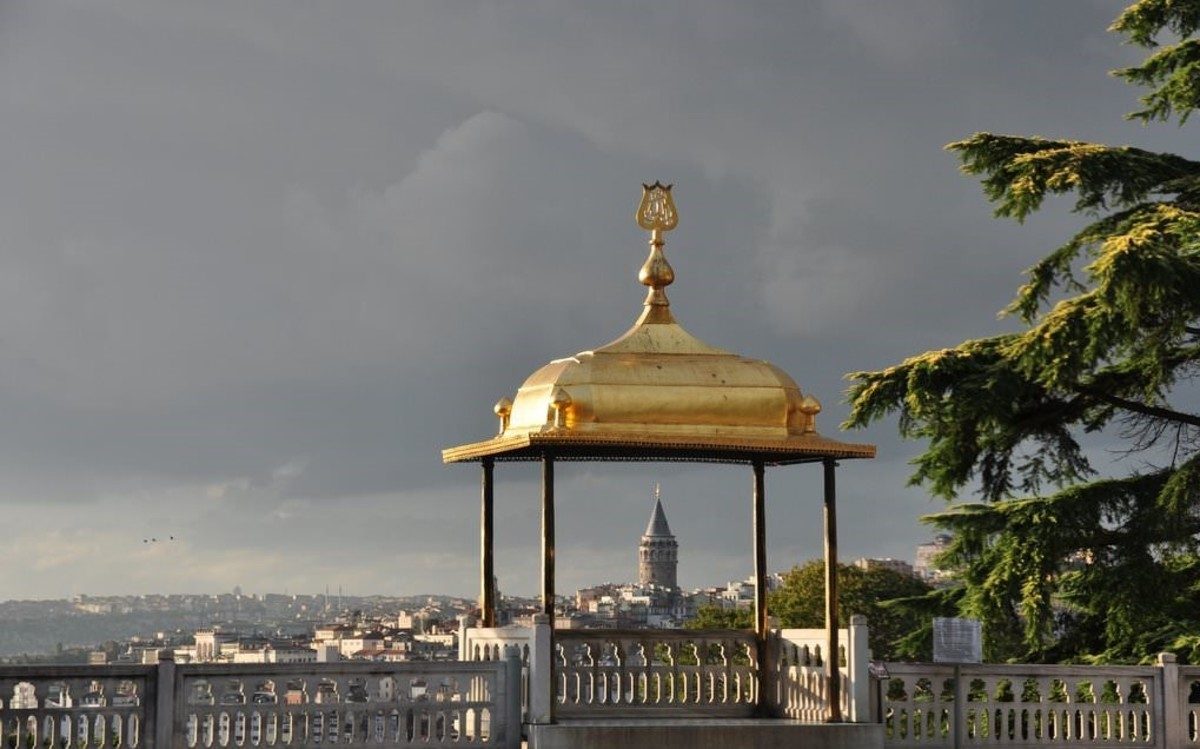
This gilded open-sided pavilion sits at the edge of the Fourth Courtyard's marble terrace and frames the classic view over the Golden Horn with Galata Tower visible in the distance. Stand at the terrace railing just beside the kiosk itself rather than inside it, since the small footprint fills fast with visitors on packages booked as Topkapi Palace Tickets tours. The gilded canopy roof also works well as a foreground frame.
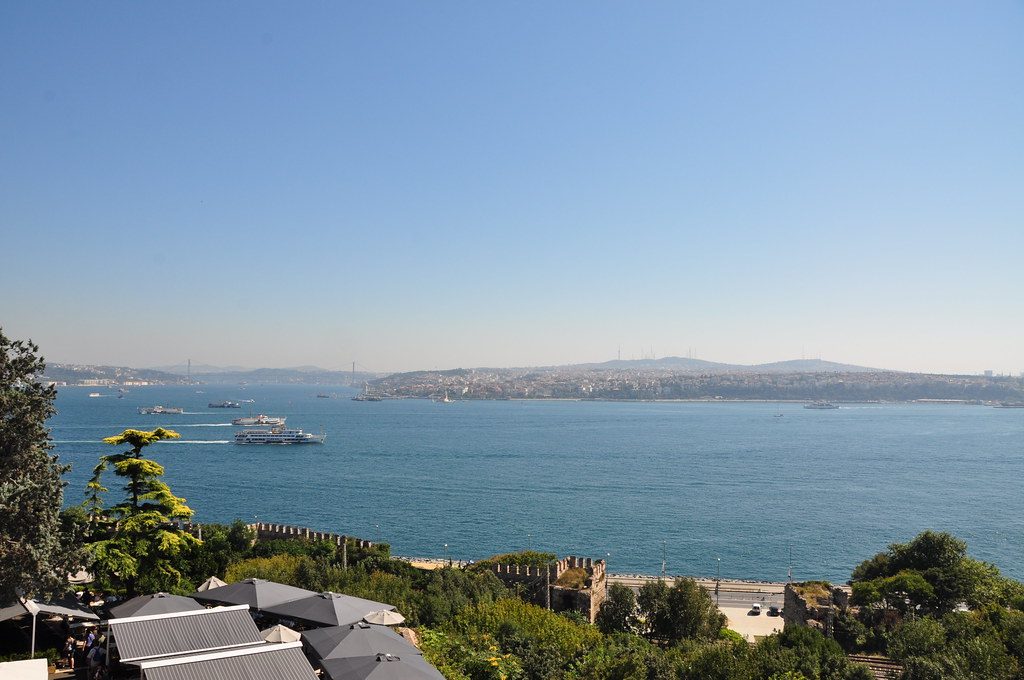
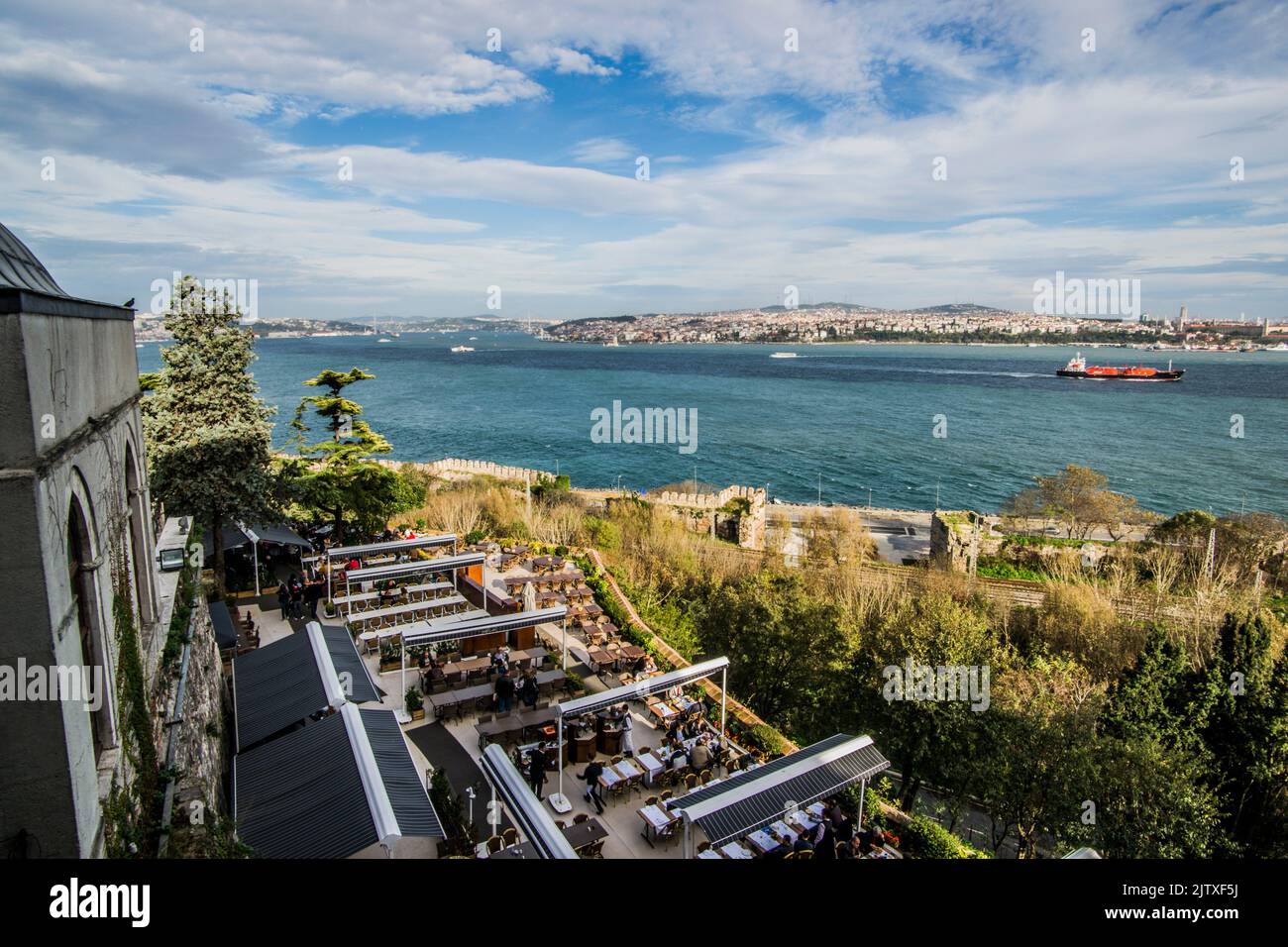
From the raised terrace walkways of the Fourth Courtyard, the view opens across the Bosphorus Strait toward the Asian shore and the Sea of Marmara, with the Mecidiye Kiosk terrace nearby offering a quieter angle on the same water. This is the widest unobstructed panorama in the whole complex and reads as a genuine Istanbul landmarks shot rather than a single-building close-up. Booking Topkapi Palace Tickets in advance still requires reaching this courtyard on foot, so budget time to walk the full terrace edge.
Also called the Middle Gate, this fortress-like entrance with twin octagonal towers marks the formal threshold into the Second Courtyard and is the most photographed exterior structure at the palace. Shoot straight-on from the paved forecourt to capture both towers symmetrically, or move to one side for an angled shot showing the conical roofs against the sky. Crowds funnel through here constantly since it also doubles as the security checkpoint.
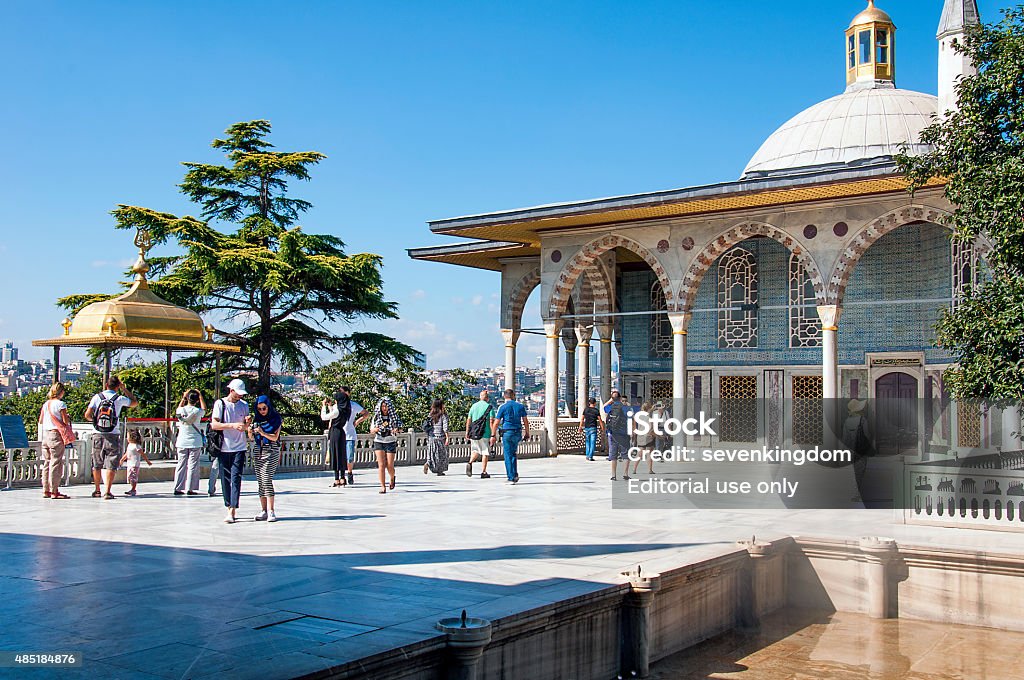
Set at the corner of the Fourth Courtyard terrace, this domed pavilion with marble and porphyry cladding offers a strong architectural subject against the greenery and water views behind it. The covered portico on its facade gives useful shade for a steady handheld shot in bright midday sun. It pairs naturally with the İftariye Kiosk on the same terrace circuit.
Real experiences from real travelers
We picked up our Topkapi Palace Tickets online the night before and walked straight past a queue that already stretched toward the fountain by nine in the morning. The stone courtyards hold the cold even in July, which made the middle hours bearable. The Baghdad Kiosk terrace has the view everyone talks about, and it earns it.
What surprised me was how much of the palace is outdoors — four courtyards linked by gates rather than one big building. The Iznik tilework in the Harem is worth the extra admission on its own. My wife spent twenty minutes just photographing one blue panel near a window.
The Treasury rooms bottleneck badly and you shuffle rather than walk. Everything else moved fine. A skip-the-line Topkapi Palace visit is the only sensible way to handle the entrance in high season.
Standing on the terrace watching ferries cut across the Bosphorus was the part I remember most. Warm wind, gulls, and the Marmara flat and silver in the afternoon. Bring water — the shaded spots fill up quickly.
Topkapi Palace Tickets tickets were straightforward to redeem at the gate with a phone screen. The Imperial Council chamber and the Tower of Justice give you a real sense of how the empire was actually run from here. Rain that morning kept the crowds thin.
As a local I go back every few years and the courtyards feel different in each season — the plane trees turning yellow in November are something else. The Sacred Relics rooms are quiet and people speak in whispers. Worth pairing with other Istanbul landmarks in the same district.
Guided Topkapi Palace Tickets tours moved us through the Harem quarters with enough context to make the layout make sense, which it does not on its own. Corridors, courtyards, dead ends, then suddenly a room of stained glass. Our guide knew which windows caught the light.
Cobblestones and gravel across all four courtyards add up. We booked an Istanbul palace tour that included headsets and it made a real difference in the louder halls. Shade is patchy in the Second Courtyard around midday.
The palace kitchens with their row of chimneys and the porcelain collection got less attention from other visitors than the jewels, and I preferred them. Cold, grey February light through the high windows suited the space. A Topkapi Palace Tickets tour booked ahead saved us standing outside in it.
Tulips were still out in the outer gardens and the whole first courtyard smelled of cut grass. The Gate of Felicity is smaller than photographs suggest but the detail up close is dense. Easy to spend three hours without noticing.
Everything you need to know for your journey
Topkapi Palace is open from 09:00 to 17:00 on the days it operates, with last entry at 16:30.
No. The Palace is closed every Tuesday, alongside a couple of religious-holiday morning closures each year.
Partial access is available. The main First and Second Courtyards are relatively level, but some pavilions and sections of the Harem involve steps and cobblestones that limit full wheelchair access.
Large suitcases, tripods, drones, and sharp objects are not permitted, and all visitors pass through metal detectors and X-ray screening at the Imperial Gate.
Photography without flash is allowed in most courtyards and galleries, including the Harem, but flash and video are prohibited inside the Imperial Treasury and Sacred Relics Room.
Arriving at the earliest opening time of 09:00, right when Topkapi Palace Tickets holders are first admitted, gives the clearest run at the Harem before tour groups build up later in the morning.
There's no strict dress code, though modest clothing is sensible given the on-site Mosque of the Agas, and flat comfortable shoes matter more than formal attire on the cobblestone courtyards.
Food isn't allowed inside the exhibition halls, but on-site cafés and a garden restaurant offer food and drink options within the Palace grounds.
The T1 tram is the simplest option: get off at the Sultanahmet or Gülhane stop, both a 5-10 minute walk from the entrance near Hagia Sophia.
Yes, and children aged 0-6 enter free, though strollers can struggle on the cobblestones and stepped pavilions inside the complex.
Topkapi Palace Tickets booked online can usually be cancelled up to 24 hours ahead for a full refund, calculated against the 2,750 TRY foreign adult ticket price; same-day cancellations are generally non-refundable.
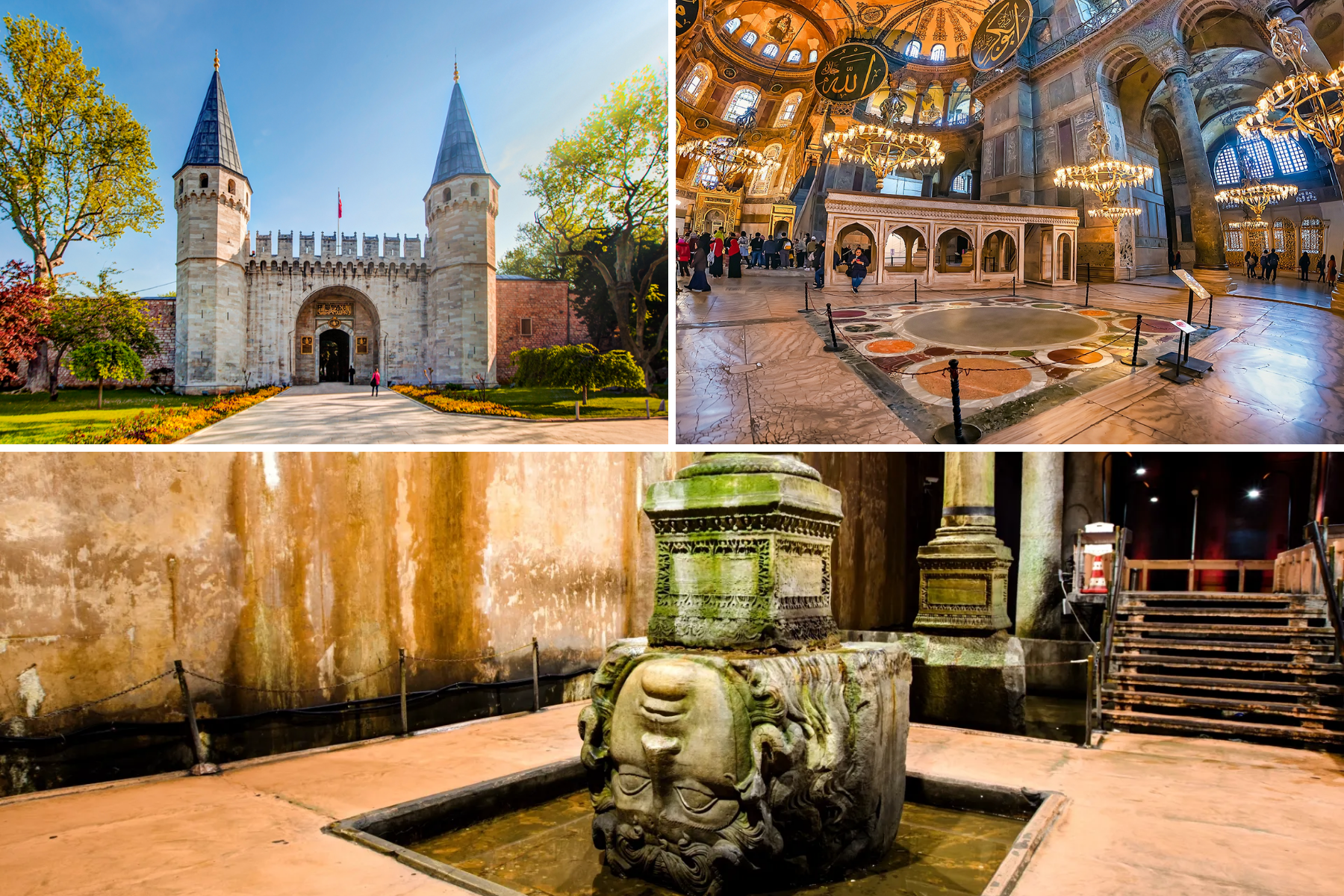
Hagia Sophia, the Blue Mosque, the Basilica Cistern, and Gülhane Park all sit within a 10-minute walk and combine naturally with a Topkapi Palace Tickets visit or broader Sultanahmet Istanbul landmarks tour.
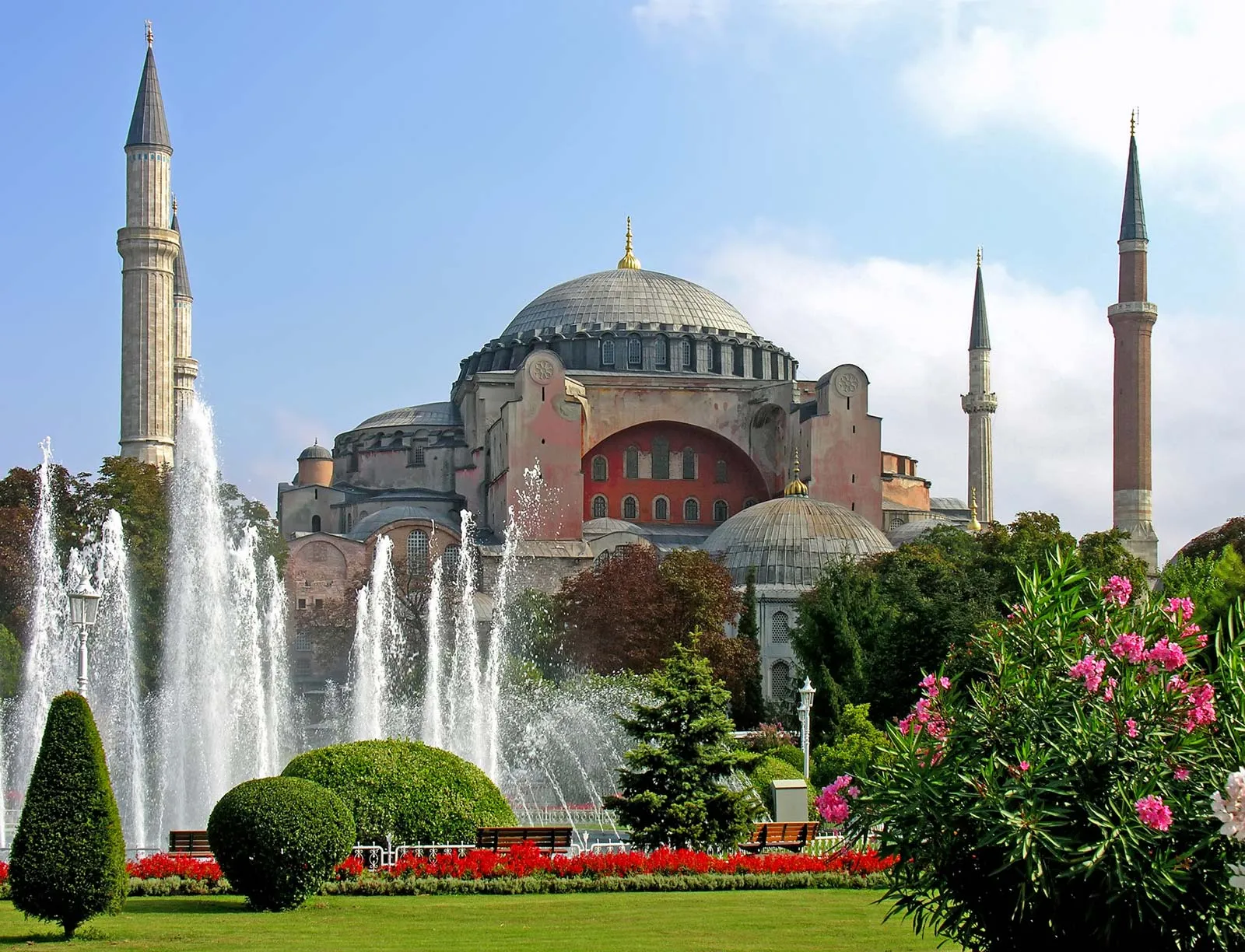
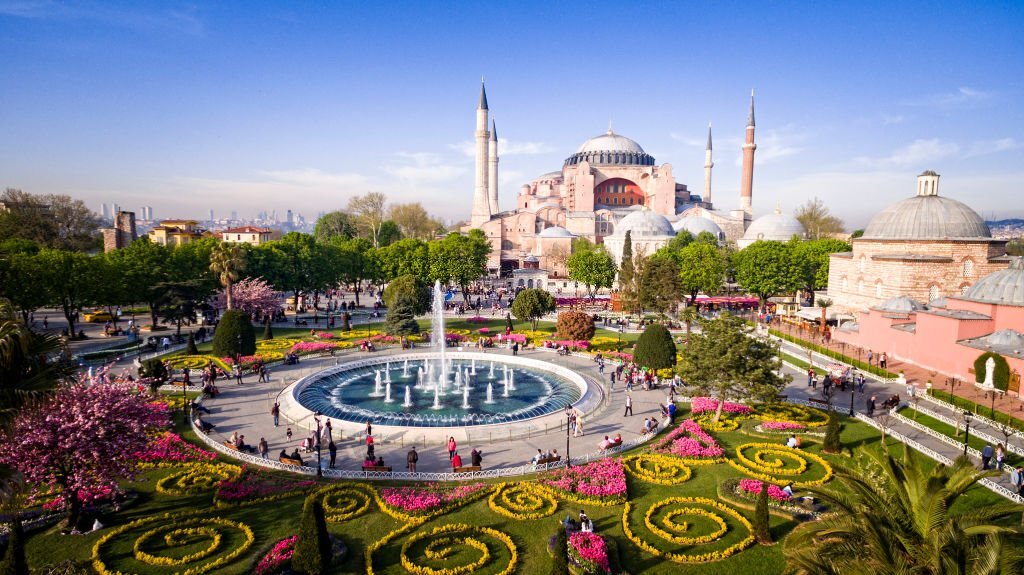
Former Byzantine cathedral and Ottoman mosque with a vast central dome, sitting just across from the Palace's Imperial Gate.
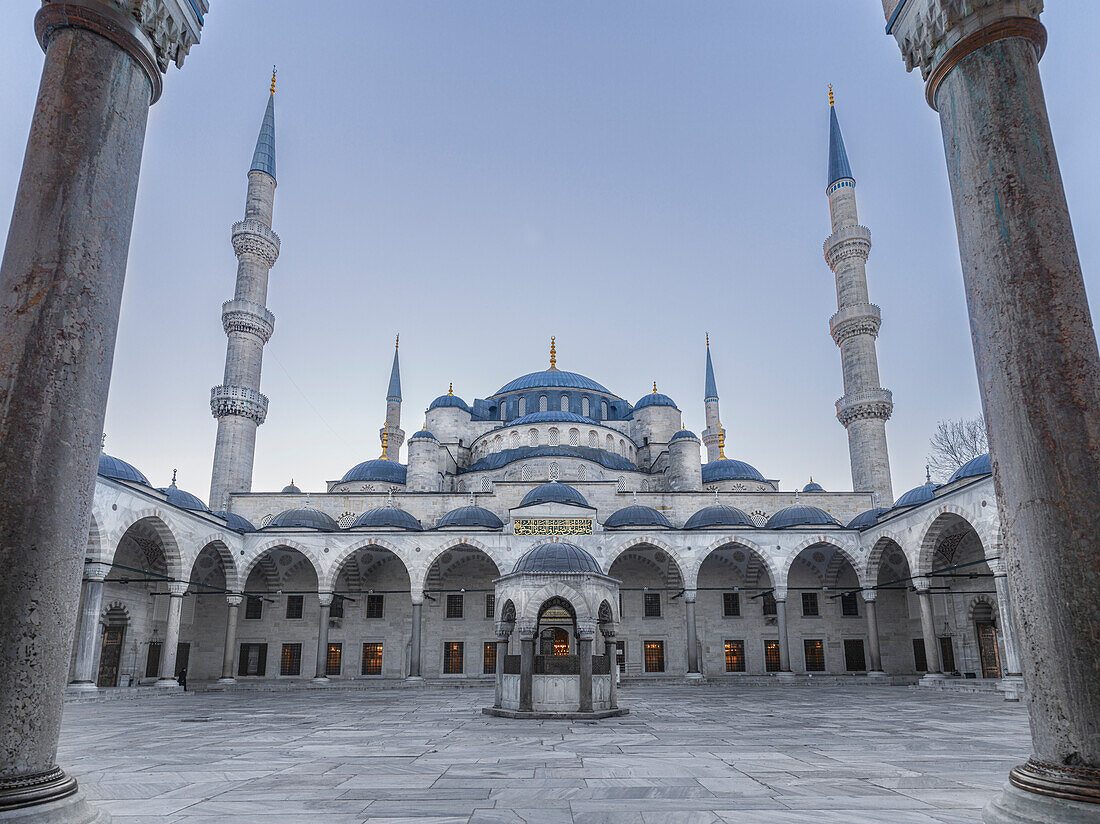
Also known as the Sultan Ahmed Mosque, recognizable for its six minarets and blue Iznik tile interior.
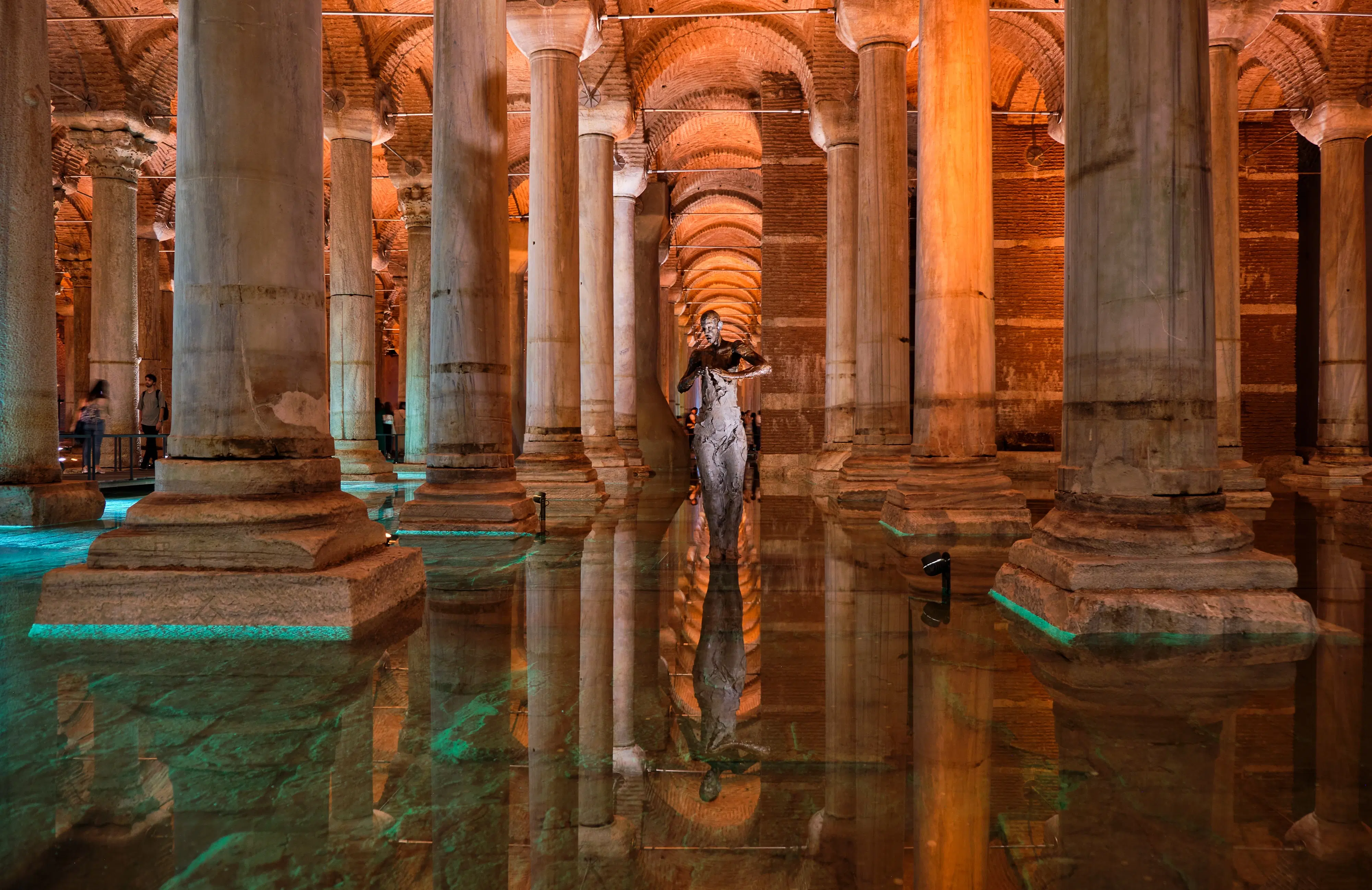
Underground Byzantine water reservoir supported by hundreds of columns, several reused from earlier structures.
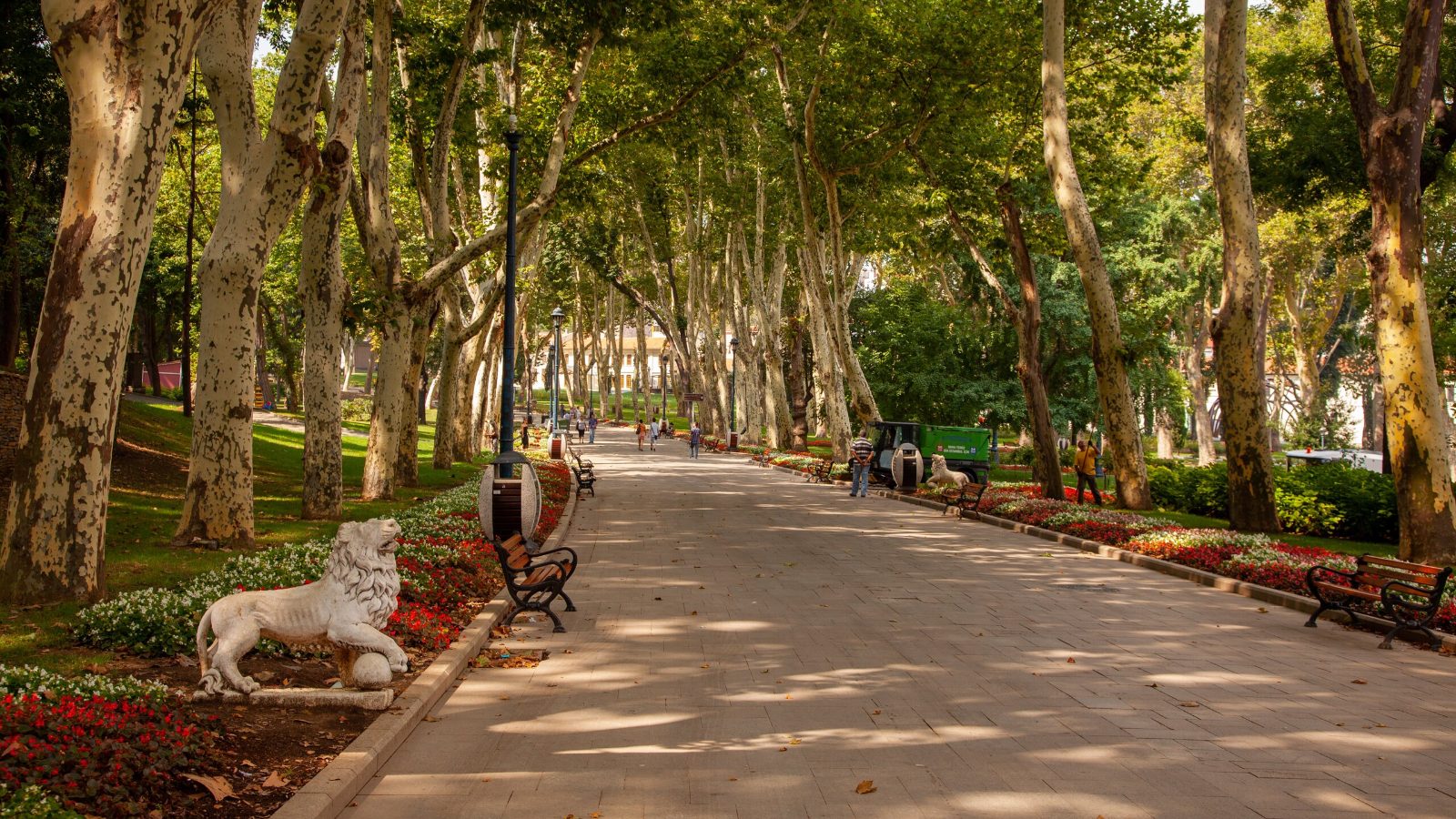
Former outer garden of the Palace, now a public park with tree-lined paths leading down toward the Bosphorus shore.
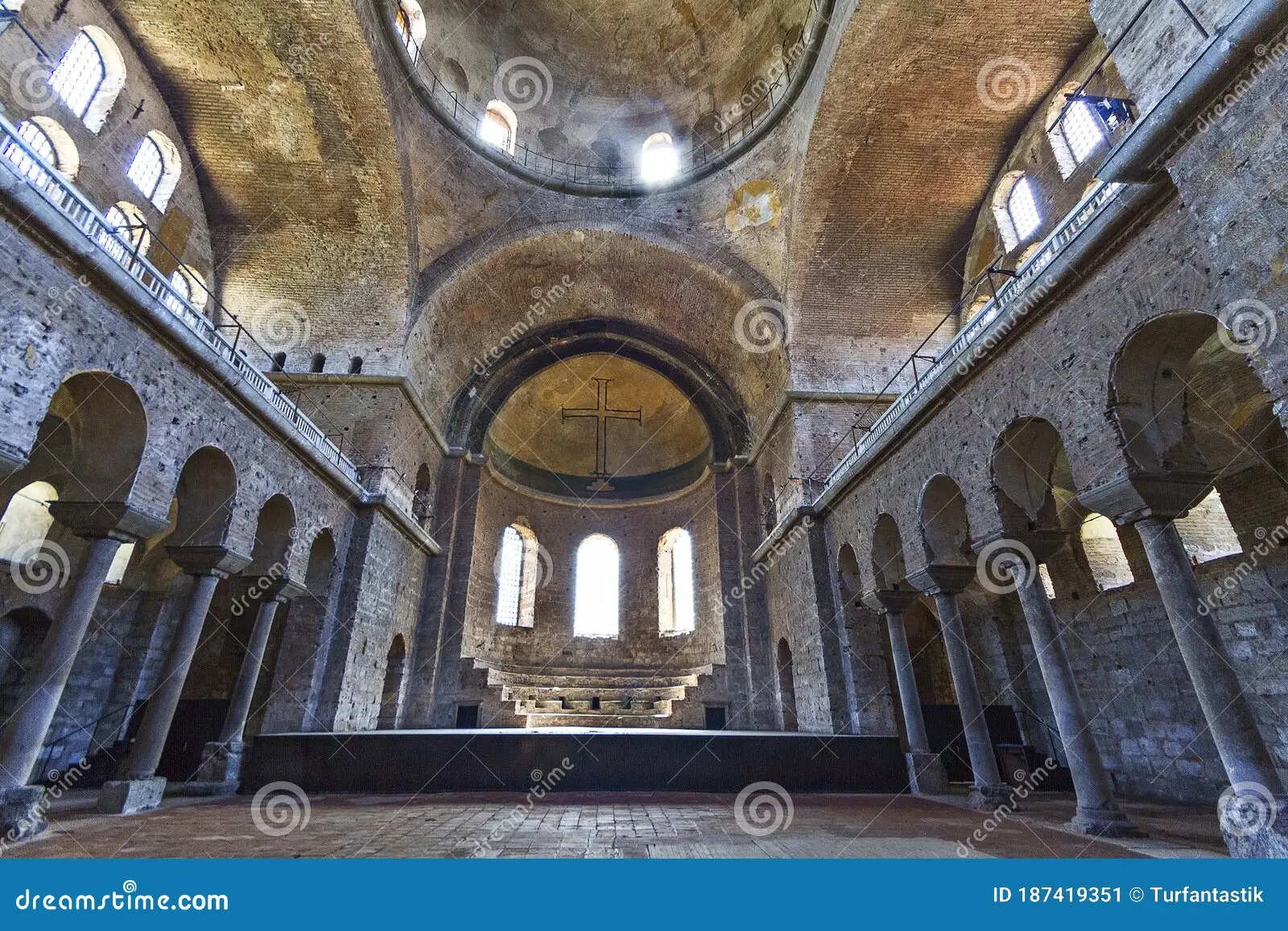
Byzantine-era church within the Palace's First Courtyard, notable for never having been converted into a mosque.
Historic hippodrome-era square connecting the Blue Mosque, Hagia Sophia, and surrounding Ottoman monuments.
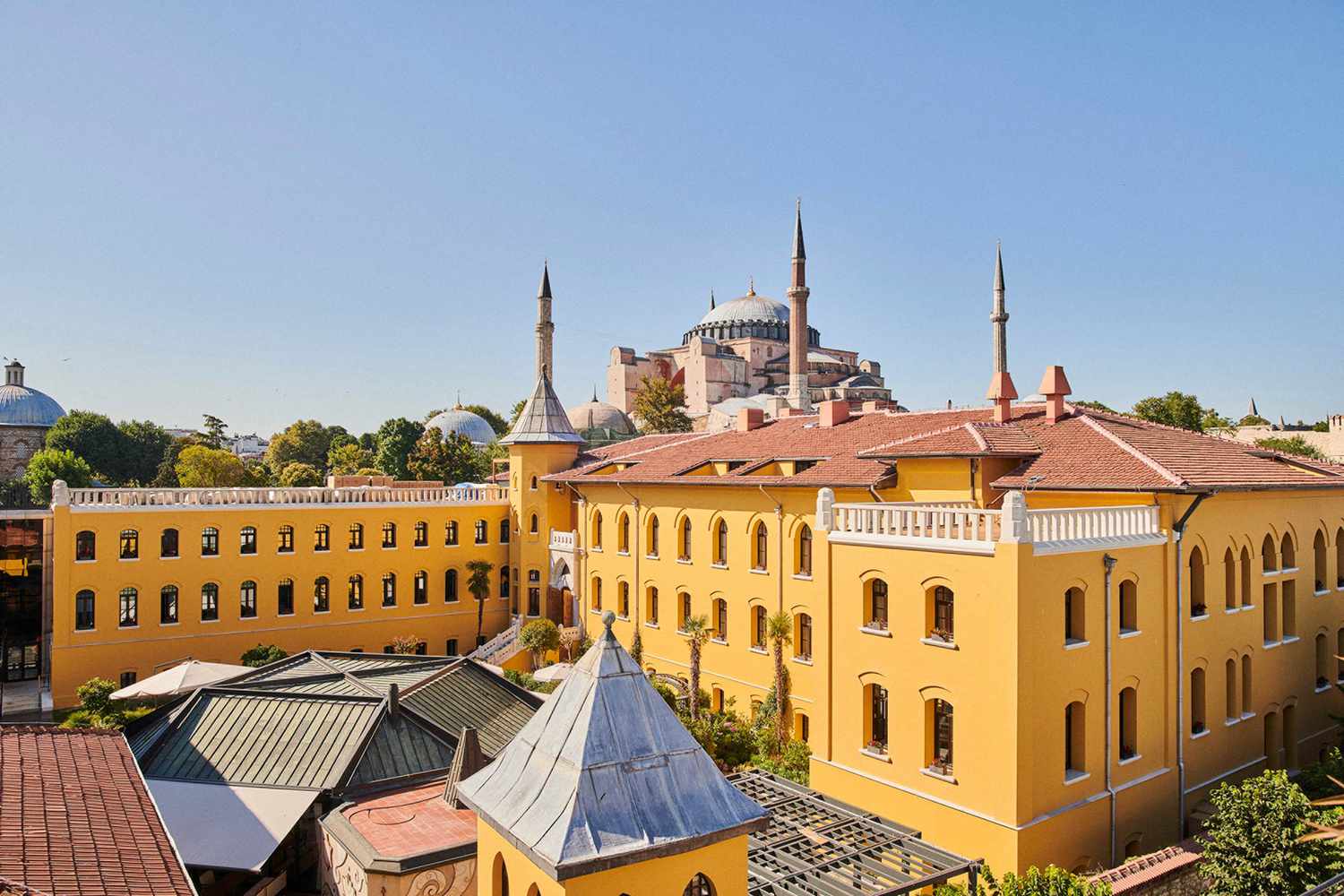
Former neoclassical prison building converted into a five-star hotel a short stroll from the Palace walls.
Cluster of restored Ottoman-era townhouses converted into small hotels in the streets directly below the Palace.
Istanbul's historic peninsula lodging hub, within walking distance of the Palace, Hagia Sophia, and the Blue Mosque.
Backpacker-oriented street with hostels and guesthouses close to the Sultanahmet tram stop.
Join thousands of happy travelers who have discovered this incredible experience
Book Your Experience Now